Tampilkan postingan dengan label innovation. Tampilkan semua postingan

Jumat, 15 Februari 2013

Announcement: The Agricultural Innovation Systems in Africa or AISA workshop


29-31 May 2013.
Nairobi, Kenya. JOLISAA is co-organizing with KARI, the PROLINNOVA network, CCAFS FSIFS-AusAID a small (80 participants expected) international workshop (the Agricultural Innovation Systems in Africa or AISA workshop) during which selected participants from different horizons will share their experiences and reflect on concepts and results about agricultural innovation processes and systems involving African small holders. Another objective will be to engage with policy-makers and other institutional decision-makers about implications and recommendations for policy, research and practice.

aisa2013

25-31 May 2013. The AISA workshop will as part of an international week devoted to Agricultural innovation in Africa. 

 A four-page announcement about this week of events can be found here .

The AISA workshop will tackle the following questions:
  • What insights and lessons can be gained from recent experiences and initiatives to promote and support agricultural innovation involving smallholders throughout Africa?
  • How are the AIS concepts and approaches being operationalised in Africa? With what successes and challenges? What added value do they bring compared to earlier or current approaches to agricultural research and development?
  • What are some of the key implications and recommendations for the way forward in terms of policy, research and practice with regard to supporting agricultural innovation in Africa, and how can the recommendations be implemented concretely in the near future?

To address the, the workshop will be structured in 5 sessions:
  • Opening and facilitated participation in the Eastern Africa Farmer Innovation Fair
  • Reflecting on conceptual issues / frameworks / approaches for assessing innovation experiences
  • Sharing main results and lessons about innovation processes/cases (posters, oral papers, facilitated group and plenary sessions)
  • Policy implications and policy-dialogue strategy and messages
  • Identifying the way forward (World Café).

Pls note this is a closed, by invitation only, event. Also note that very limited opportunities exist for sponsorship, as most participants are expected to be self-sponsored through their respective programs and projects.

Kamis, 31 Januari 2013

Research-into-use. An Independent Review

Research-into-use. An Independent Review 
D. Shields, J. Wyeth, G. Gill; 2012, viii + 51 pp.
November 2012 (Final draft) 1.0MB

This report offers an independent review of the Research-into-Use (RIU) programme. RIU was established in 2006 with an inception period that lasted until June 2007. Following a Mid-term Review (MTR) in middle of 2009 there was a major restructuring and this new Review focuses mainly on the period after that and up to May 2011.

The purpose of the Review is to provide an independent analysis of the programme that focuses on actual and potential impact where it can, and especially on outcomes and outputs. It looks at some of the effects the interventions have had on institutions and systems so far and specifically asks:
  1. What has RIU delivered and what likely impacts can be foreseen? 
  2. What has been successful and why? 
Chapter 1 provides a brief introduction to the programme and to the Review. Chapter 2 covers findings of on field activities, and Chapter 3 covers the findings on the research process. Chapter 4 brings together some of the main conclusions reached by the Review in a number of areas.

Related: 
Bringing New Ideas into practice. Experiments with agricultural innovation. Learning from Research Into Use in Africa.
P Gildemacher , R Mur (ed.)
184 pages
Published 2013

KIT studied a selection of projects from the RIU Africa portfolio:
  • the Nyagatare maize platform in Rwanda; 
  • the cowpea platform in Kano state, Nigeria; 
  • the pork platform in Malawi, 
  • the Farm Input Promotions (FIPS) Best Bet in Kenya, 
  • and the Armyworm Best Bet in Kenya and Tanzania. 
Through a mix of quantitative and qualitative methods the change in capacity to innovate, the household level poverty impact, the main lessons learned and the value for money were assessed.

The analysis of the five cases did allow for the development of an analytical model that can assist in decision-making on investments in agricultural innovation. Interventions aimed at agricultural development through innovation would do well to consider two types of results: household level impact at scale, and an improved capacity to innovate. Three interlinked components, needs and opportunity identification, experimentation and bringing into routine use, were distinguished to analyse the process of getting from new ideas to impact at scale. The roles of different stakeholders are discussed.
Background:
The Research Into Use programme (RIU) came to a close on 31st December 2012. The RIU was commissioned in 2006 to address ways to scale up successful innovations from agricultural research. The intention of RIU was to deliver the impact from the 10-year (1995 to 2005) DFID-funded suite of programmes on Renewable Natural Resources (RNRRS).

Selasa, 29 Januari 2013

Dialogue on Reimagining Agricultural Research


29-31 January 2013. Penang. Malaysia. The 2013 Dialogue on Reimagining Agricultural Research in Development brings together leaders in agricultural research and development policy and practice to address these questions. By doing so at the start of the new CRPs working on agricultural systems the Dialogue is designed to guide their implementation so as to increase both the intensity and scale of their impact on the poor.

Objectives
  • Provide the CRPs with an opportunity to learn from, and build upon, previous experience with integrated approaches to agricultural research and development
  • Identify how these research programs can foster innovation to improve on these approaches, improve livelihoods in the communities where they work, and achieve significant impacts at the scale of agricultural landscapes
Outputs
  • Guidance on innovative approaches to be taken forward through the CRPs
  • A community of practice will work together to address these issues as the CRPs proceed
  • A refereed publication bringing together learning from the Dialogue
The following resources have been shared by dialogue participants and offered as a beginning of the conversation to re-imagine agricultural research in development. Here is an overview of the most relevant documents related to IAR4D:


Senin, 28 Januari 2013

Renewing innovation systems in agriculture and food

21 janvier 2013. Agropolis International, Montpellier. Conférence-débat "Quoi de neuf sur l’innovation ?"

Conférence-débat organisée à l’occasion de la sortie du livre " Apprendre à innover dans un monde incertain. Concevoir les futurs de l'agriculture et de l'alimentation", issu du symposium ISDA 2010/ Innovation and Sustainable Development in Agriculture (28 juin- 1er juillet 2010, Montpellier)

Ce livre rassemble les contributions de chercheurs et experts internationaux, sous forme de synthèse ou de points de vue, sur l’innovation dans l’agriculture et l’agro-alimentaire pour faire face aux défis d’aujourd’hui.

Le livre est disponible en anglais (Wageningen Academic Publishers) et en français (Quae).


Renewing innovation systems in agriculture and food
Present-day society asks more from agriculture than just the production of food. Agriculture is now required to be concerned with the quality of food, ecosystem services, inclusion of marginalized populations, revitalization of rural territories, energy production, etc.

This opening up of the future of agriculture encourages rural actors to experiment with new farming systems, using imagination, creativity and determination to replace dominant models. At the same time, low-cost mass-production systems continue on their way, with promises of a future based on green technologies. In this discussion it is important to consider what kind of sustainable development societies really want. Which innovations will help in achieving these developments? What role can research and public policies play in supporting the emergence of these innovations?

This book takes the debate beyond the purely technical options and considers social and institutional innovations as well. It demonstrates that innovation is the result of a confrontation between visions of actors who often have divergent interests. There is no single path towards sustainable development and we must find ways to encourage the emergence and co-existence of different types of agriculture and food systems. The success of transitions will not only depend on our capacity to rethink existing models, but especially on our willingness to embark on a creative learning process from which we will inevitably emerge transformed.
Download table of contents of the book 'Renewing innovation systems in agriculture and food'. (PDF file)


Senin, 03 Desember 2012

Innovative Composting Alternatives

26-30 November 2012. Accra, Ghana. Promoting Affordable Sources of Plant Nutrients in Africa Through Innovative Composting Alternatives. Co-sponsored by African Union Commission Department of Rural Economy and Agriculture.  

The objectives of this five-day training program included:
  1. Improving participants’ capabilities to overcome constraints that hamper waste recycling and the feasibility of recycling strategies and their contribution to ensuring sustainable agricultural productivity and improved sanitation in rapidly growing rural, urban and peri-urban environments.
  2. Increase participants’ knowledge of the principles and methodologies of solid waste and fecal sludge collection, storage and handling to ensure efficiency.
  3. Update participants on the development of innovative composting technologies to enhance the effectiveness, aesthetics and applicability of the composted material to increase acceptability among smallholder farmers.
  4. Increase participants’ knowledge on: (i) proper handling of composted organic fertilizer to eliminate any risks associated with their use; (ii) calculate optimal application rates; and (iii) the long-term benefits of their use on soil health.
  5. Identify sound policy options for promoting municipal and human waste fertilizer use and supply in Africa.

Jumat, 23 November 2012

Innovation System Perspective in Agriculture and Rural Development for smallholder farmers

19-21 November 2012. South Africa. Eleventh regional conference of the Southern and Eastern African Association of Farming Systems Research-Extension (SEAAFSRE). The conference, whose theme was ‘Innovation System Perspective in Agriculture and Rural Development for smallholder farmers’ was intended to share experiences and best practices in moving agriculture from subsistence to commercial among resource-constrained farmers in the region.

In particular, the conference shared practical experiences on the role innovation, agricultural training, research and extension can play in enhancing a value chain orientation in smallholder agriculture.

The conference was attended by individuals and organizations involved in Farming Systems Research-Extension (FSRE) work including farmers, policy makers, planners, trainers, researchers, advisory services providers, non-government organizations (NGOs), elected officials and donors. 

The objectives for the conference were:
  • To share experiences on best farming systems research and extension practices and strategies for commercializing agriculture and reducing hunger and poverty. 
  • To provide an opportunity for farmers, trainers, researchers, agricultural advisory and support service providers and elected officials to debate and learn together how they might individually and collectively make progress towards millennium targets in poverty, hunger and environment through innovations in smallholder farming systems. 
Outputs
  • A profile of innovative farming systems research and extension opportunities for commercializing agriculture and reducing hunger, poverty and environmental degradation. 
  • Peer reviewed proceedings of the conference detailing the achievements, lessons learnt and opportunities in the region. 

Rabu, 21 November 2012

THE EUROPEAN INNOVATION PARTNERSHIP ON "AGRICULTURAL PRODUCTIVITY AND SUSTAINABILITY"

19/11/2012, Brussels.Conference: The European Innovation Partnership on Agricultural Productivity and Sustainability (EIP) on Agricultural Productivity and Sustainability – Priorities and Delivery Mechanisms

The European Innovation Partnership on Agricultural Productivity and Sustainability (EIP) creates working interface between agriculture, bio-economy, science, advisors, environmental groups, consumers, and other stakeholders at EU, national and regional level. It helps to bring innovative research results faster from science to practice, to encourage the sharing of knowledge and experience, and to ensure a systematic feedback about needs from practice to the scientific community.

The aim of this conference was to tap into the collective knowledge of the stakeholder and research communities. It provided a forum for a genuine brainstorming on the challenges and opportunities to be addressed by the EIP with a particular focus on the functioning and funding of Operational Groups. The outcome of the conference will feed into the work of the Steering Board for the EIP.

The conference brought inter alia together:
  • Agricultural stakeholders, European and national farmers' organisations
  • Representatives of Member States ( Delegates of the Standing Committee on Agricultural Research (SCAR) and of the Rural development Managing Authorities, representatives of national advisory bodies)
  • Researchers and academics
  • Environmental NGOs and Civil Society organisations
  • Representatives of on-going initiatives within the research framework
  • Advisors and innovation brokers
An example on reducing emissions from livestock

Senin, 15 Oktober 2012

Agricultural Innovation cases in Kenya


This report on Agricultural Innovation cases in Kenya covers the first phase of the project which was the development of an inventory for each country that documents and describes examples of multi-stakeholder innovation processes that have relevance to smallholder agriculture. The inventory has sought to identify cases where local knowledge has made a contribution to the innovation process. The inventory has allowed for a broad understanding of innovation processes and their dynamics which will be explored in more detail through the next phase of the project, the collaborative assessment of three cases
Innovation cases in Kenya were identified through a number of different avenues. Discussions took place with possible case-holders to determine whether or not their cases would be relevant to Jolisaa.

The following criteria or guidelines were used for initially identifying cases for inclusion in the inventory : (1) Are they relevant to smallholders? (2) Do they show some level of novelty? (3) Are there multiple stakeholders?

The cases were only retained in the inventory if they met the following criteria: (1) experiences where at least 3 stakeholders had been actively involved (thus trying to avoid the many cases in which research entertains an exclusive relationship with a group of farmers), (2) experiences which were at least 3 years old (thus trying to target processes that were not in their infancy).

From the range of different cases explored up to this point, 18 cases in Kenya were finally selected.

The cases consist of: (a) Identification ; (b) The story line in a nutshell ; (c) The innovation context ; (d) Description ; (e) Main stakeholders involved and their roles in the innovation process ; (f) History / dynamics of the innovation process ; (g) Results & effects of the innovation process so far (adoption) ; (h) Main lessons in light of the JOLISAA goals and questions

Case Studies: 

1. Learning about management of prosopis in Baringo
2. Domestication and processing of wild Aloe (secundiflora and Turkanensis) in Baringo District
3. Participation of local communities in conservation of Arabuko Sokoke forest through butterfly farming
4. Production of contract seed maize production in the Perkerra irrigation scheme
5. Solving conflicts by managing water use through water resources users association on River Waseges Basin in Baringo
6. Private Public Partnership in the management of soil acidity in Western Kenya using lime
7. Public Private Partnership for commercial production of Gaddam sorghum in Makueni county,
Eastern Kenya
8. The introduction and cultivation of oil palm tree for income generation in Western Kenya
9. Institutional framework engaged by goat breeders associations in Kitui and Mwingi District
10. Improvement of farmer livelihoods through mango processing and marketing
11. Small input packs for promotion of yield enhancing inputs
12. Dairy milk production processing and marketing in Meru
13. Tissue culture bananas for small scale producers in Kenya
14. Finger millet seed saving and outscaling in Machakos district
15. Processing and cooling of milk through solar energy in the Kenyan South Coast
16. 'Jua Kali’ rice production and marketing outside the Mwea Irrigation Scheme
17. Ecological management of stem borer using pushpull technique in smallholder farms
18. Commercialization of grafting, pruning and spraying of Avocadoes and Mangoes

Related:
The 10th European IFSA Symposium, 1-4 July 2012 in Aarhus, DenmarkProducing and reproducing farming systems: New modes of organisation for sustainable food systems of tomorrow


Presentation of the paper:
What does an inventory of recent innovation  experiences tell us about agricultural innovation in Africa?
Bernard Triomphe, Anne Floquet, Geoffrey Kamau, Brigid Letty, Simplice Davo Vodouhe, Teresiah N’gan’ga, Henri Hocdé (July 2012, 10 pages)

Agricultural Innovation cases in South Africa


JOLISAA (Joint Learning in Innovation Systems in African Agriculture) is a European Union funded research project that is coordinated by the French research organisation, CIRAD, and operates in South Africa, Kenya and Benin. In South Africa, the project is hosted by the Department of Agriculture, Extension and Rural Development at the University of Pretoria. The JOLISAA project aims to increase understanding of multi-stakeholder innovation processes and recognises the benefit of combining different forms of knowledge, including local knowledge.

This report on Agricultural Innovation cases in South Africa covers the first phase of the project which was the development of an inventory for each country that documents and describes examples of multi-stakeholder innovation processes that have relevance to smallholder agriculture. The inventory has sought to identify cases where local knowledge has made a contribution to the innovation process. The inventory has allowed for a broad understanding of innovation processes and their dynamics which will be explored in more detail through the next phase of the project, the collaborative assessment of three cases.
  1. collection of individual cases: Compilation of inventory cases
  2. national inventory report (provisional version): National inventory report SA
Innovation cases in South Africa were identified through a number of different avenues. The key approach was to make use of programmes and networks, in particular PROLINNOVA and the South African Society for Agricultural Extension (SASAE) that the members of the coordinating team were already involved with. Contact was also made with individuals and organisations that team members thought might be aware of relevant cases.

Discussions took place with possible case-holders to determine whether or not their cases would be relevant to Jolisaa. At the National Workshop held in Pretoria in November 2010, participants were given the opportunity to showcase innovation processes that they had been involved with. The market place also created awareness about the types of multi-stakeholder processes that existed in South Africa.

The following criteria or guidelines were used for initially identifying cases for inclusion in the inventory (they were also sent to potential participants of the first national workshop to identify cases to be showcased at the workshop’s marketplace): (1) Are they relevant to smallholders? (2) Do they show some level of novelty? (3) Are there multiple stakeholders?

Following the documentation of the 24 cases in the inventory, they were again reviewed by the coordinating team to identify those that did not fit. The cases were only retained in the inventory if they met the following criteria: (1) experiences where at least 3 stakeholders had been actively involved (thus trying to avoid the many cases in which research entertains an exclusive relationship with a group of farmers), (2) experiences which were at least 3 years old (thus trying to target processes that were not in their infancy).

From the range of different cases explored up to this point, only 11 were finally selected. A cross analysis of the 11 cases in the inventory was undertaken to build a better understanding of innovation processes is the field of agriculture in South Africa.

The cases consist of: (a) Identification ; (b) The story line in a nutshell ; (c) The innovation context ; (d) Description ; (e) Main stakeholders involved and their roles in the innovation process ; (f) History / dynamics of the innovation process ; (g) Results & effects of the innovation process so far (adoption) ; (h) Main lessons in light of the JOLISAA goals and questions

Case Studies:

1. Production and marketing of a new cash crop (cherry peppers)
2. Adapting outside knowledge to increase food security in marginal areas: the case of the low cost protein supplement for chicks
3. Developing a bulk buying system for agricultural inputs and equipment
4. Development of a winter feed supplementation option
5. Mainstreaming of traditional healers’ indigenous knowledge through manufacturing, processing and patenting a mosquito repellent from the Lippia javanica shrub
6. Collaboration of research, extensionist and farmers in developing bio-pesticides to control vegetable pests
7. Development and adaptation of in-field rainwater-harvesting techniques
8. Developing and testing an irrigation management tool
9. Maize seed production innovation system in the Vhembe district (Limpopo Province)
10. From unemployment to a viable Egg-layer production cooperative in Mahonisi Village - Limpopo Province
11. Enhancing farmers’ organizational capacities and experimentation for managing soil fertility

Integrating Tools for Assessing National Agricultural Innovation Systems

8th – 9th October 2012. Orientation Workshop for National AIS Focal Persons. FARA assesses the functionality of national agricultural innovation systems (NAIS) in selected countries in sub-Sahara Africa. This is to enable identification of priority areas, mechanisms and actionable recommendations for support and interventions by FARA, regional and global partners, and national actors toward strengthening specific aspects of the NAIS.

The workshop at FARA was an initial engagement with national focal persons on the methodology and conduct of the national agricultural innovation systems (NAIS) assessment exercise. It will also involve integrating the tools for assessing the national agricultural innovation systems (NAIS)  with FARA’s e-Capacities facility, as a platform for survey data management. The focal persons will in turn train enumerators drawn from targeted organizations of the national agricultural innovation systems (NAIS)  on specific methodological and reporting guidelines.

The pilot countries were selected on a sub-regional basis as well as the stage of CAADP country processes. Strengthened NAIS are an imperative for effective implementation of the CAADP country investment plans and stimulating agriculture-led development of African countries.

Country focal persons from the pilot countries of Kenya, Rwanda, Madagascar, Uganda, Burkina Faso, Benin, Gambia, Ghana, Senegal, Botswana, Lesotho, Zambia, and Malawi; representatives of the three SROs, ANAFE and RUFORUM; and local Ghanaian pilot organizations for beta-testing of the e-Capacities facility attended the workshop.

The methodology for the NAIS exercise, modalities for data collection and reporting, and the e-Capacities facility were discussed on the first day of the workshop. On the second day, the participants visited University of Ghana’s Faculty of Agriculture, the Ministry of Food and Agriculture, and the Council for Scientific and Industrial Research (CSIR) to witness onsite installation and demonstration of the e-Capacities platform.

The workshop served as a training of trainers forum, whereby the focal persons were required to train respective country enumerators upon their return home on how to undertake the NAIS exercise.

Background on the e-Capacities facility:
In keeping with its continental oversight and observatory roles, FARA has developed an electronic capacities (e-Capacities) mapping facility that will integrate the features of an online marketplace and a knowledge hub. The facility will:
  • enable remote and real-time update of organizational capacity status 
  • overlay the supply and demand sides of organizational capacity in order to identify gaps and surpluses track career progression of targeted scientists and professionals

Kamis, 11 Oktober 2012

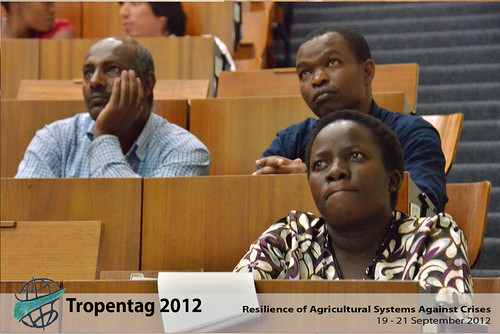
Tropentag 2012, Resilience of agricultural systems against crises

19–21 September 2012, Göttingen, Germany. The Tropentag is a development-oriented and interdisciplinary conference. It addresses issues of resource management, environment, agriculture, forestry, fisheries, food, nutrition and related sciences in the context of rural development, sustainable resource use and poverty alleviation worldwide.

The annual Conference on Tropical and Subtropical Agricultural and Natural Resource Management (TROPENTAG) is jointly organised by the universities of Bonn, Göttingen, Hohenheim, Kassel-Witzenhausen, Hamburg, Zurich as well as by the Council for Tropical and Subtropical Research (ATSAF e.V) in co-operation with the GIZ Advisory Service on Agricultural Research for Development (BEAF).

Tropentag 2012 was organised jointly by the faculty of agricultural sciences and the faculty of forestry of the Georg-August Universität Göttingen and the faculty of organic agricultural sciences of the University of Kassel. The conference venue will be in Göttingen, Germany. All students, Ph.D. students, scientists, extension workers, decision makers, politicians and practical farmers, interested and engaged in agricultural research and rural development in the tropics and subtropics are invited to participate and to contribute. 

Water and energy
Post-harvest technology
Food, health and nutrition

Modelling
Systems modelling
Systems modelling II

Development Cooperation
Soils and resilience (CIAT session)
Poetry route
Central issues on resilience of agricultural systems against crises (GIZ session) 


The Joint Learning in Innovation Systems in African Agriculture (JOLISAA) program, represented by Vincent Archiba Schmitt, shared recent experiences on innovation processes involving multiple stakeholders and types of knowledge.

Innovation Systems (IS) perspective inspires the framework of the JOLISAA research. IS stressed that the flow of technology and information among stakeholders is key to innovative processes. The project uses several avenues (inclusion/exclusion criteria, storyline, common underlying concepts, and iterative processes) to identify relevant innovations for deeper assessment and joint learning. JOLISSA lists selected innovations in three national inventories (BeninKenya, and South Africa).

Jointly, practitioners and researchers assess 13 cases from the existing national inventories. The key steps in this collaborative case assessments are: i) planning meetings, ii) focus group discussions, iii) multi-stakeholders feedback, and iv) literature review.

First findings of the study show that African innovation processes at smallholders level have the capacities to take advantage of opportunities, create markets, and manage natural resources. The project recommends long term support (min. 10 years) in dynamic, iterative and flexible manner adapted to specificities of context. This allows unfolding of multiple stakeholders processes and widespread impact of innovations in the African agricultural sector.

If you are interested and work on this topic, do not miss the international event JOLISAA will organize late may 2013, Kenya.

Proceedings
of the 2012 conference as PDF (2.3MB)

Tropentag 2013 will be held at the University of Hohenheim,
17 - 19 September 2013

Title: Agricultural development within the rural-urban continuum

Selasa, 18 September 2012

Facilitating innovation platforms to trigger institutional change in West Africa

One finger cannot lift a rock. Facilitating innovation platforms to trigger institutional change in West Africa
Editors: Suzanne Nederlof, Rhiannon Pyburn 
© 2012, Royal Tropical Institute (KIT) 
ISBN 9789460221972 | KIT Publishers, Amsterdam | Paperback | 142 p. |  

There is growing consensus on the value of multi-stakeholder approaches to natural resource management, institutional change, poverty alleviation, climate-change mitigation and adaptation, and food security. Using such approaches to foster institutional change implies a special twist.

This book presents the hands-on experience of facilitators who have struggled at the coal face with this approach. We hope that others in this emerging profession will be able to learn from their experience.

The research programme Convergence of Sciences (CoS, 2002–6), funded by the Dutch Ministry of Foreign Affairs, went through a learning process with respect to what determines opportunity for African smallholders. Typical for the time when it was conceived, CoS focused on participatory technology development in eight West African communities. The conclusion was that, yes, optimally appropriate technologies can help smallholders, but the institutional setting often makes them either impossible or unattractive to implement.

Smallholders face such small windows of opportunity that appropriate technology is often irrelevant. What emerged is that opportunity can be captured only by creating appropriate conditions, i.e., by tackling institutional factors.

At the time of writing, CoS-SIS still has two years to go. Its research is ongoing. So this book cannot deliver the programme’s final conclusions or report on institutional change. Instead, it describes the experiences of nine part-time “research associates”, who facilitate forums created by CoS-SIS, called “concertation and innovation groups”. These nine forums, one per facilitator, each deal with a topic area (or “domain”) in one of the three countries.

The production of this book has been co-funded by CoS-SIS and KIT. KIT’s contribution to this publication has been made possible thanks to core support received from the Dutch Ministry of Foreign Affairs

Kamis, 06 September 2012

African female leaders awarded the Yara Prize

September 05, 2012. Oslo, Norway. The Yara Prize 2012 is being awarded to Dr. Agnes Kalibata, Minister of Agriculture and Animal Resources in Rwanda, and to Dr. Eleni Gabre-Madhin, outgoing CEO of the Ethiopian Commodity Exchange (ECX) in Ethiopia.

The Yara Prize Committee has selected two prominent African female leaders for their work on groundbreaking areas for the African Green Revolution: effective public policies in support of agricultural growth and profound innovation in agricultural markets.

Both leaders have demonstrated how transformative change can be achieved in a complex and challenging environment. They have applied innovative approaches, collaborating with partners in new ways. Their achievements are fit to inspire other countries to transform the productivity and sustainability of their agricultural sectors.
“Yara creates impact by addressing global challenges. By awarding the Yara Prize, we salute the champions of sustainable agricultural development. I wish to extend my personal congratulations to the laureates,” Jørgen Ole Haslestad, President and CEO of Yara and Chairman of the Yara Prize Committee, said.
The two laureates will be celebrated at the State Banquet / Gala night on September 27 during the African Green Revolution Forum (AGRF) 2012 in Arusha, Tanzania.

Dr. Agnes Kalibata is being awarded the prize for her great leadership in the transformation of food security and agricultural development in Rwanda in a relatively short period of time. She currently serves as the Minister of Agriculture and Animal Resources for the Republic of Rwanda. For six years, Minister Kalibata has been the architect of the remarkable transformation of Rwandan agriculture. Rwanda has moved from having a food deficit to being a country that is largely food self-sufficient. Over 1 million Rwandans have moved out of poverty between 2005 and 2011.

Dr. Eleni Gabre-Madhin is the founder and outgoing CEO of the Ethiopia Commodity Exchange (ECX). She is being awarded the prize for showing visionary and remarkable leadership in managing the transformation process toward an efficiently functioning market, especially for smallholder coffee producers in Ethiopia.

The ECX has had a far-reaching impact in Ethiopia in several areas of agriculture and in the lives of small farmers since its inauguration in 2008. Under her leadership, ECX’s growth has seen a strong increase in volumes every year, from trading 138,000 tons in the starting year 2008/2009 to 601,000 tons in 2011/2012. The value of ECX trades reached USD 1.2 billion in 2011/2012, representing up to USD 20 million per day.

Rabu, 01 Agustus 2012

Stage méthodologique d'appui aux innovations en agriculture familiale

31 juillet, 1er et 2 août. Gembloux, Belgique. Dernière phase de la réalisation du "Stage méthodologique d'appui aux innovations en agriculture familiale", co-organisé par GxABT et ADG.

Cette année, le stage a accueilli 15 participants (12 hommes, 3 femmes), tous professionnels dans le domaine du développement rural dans leur pays respectif. Ils proviennent de 8 pays différents : Bénin (4), Burundi, République Démocratique du Congo, Burkina Faso, Côte d’Ivoire (2), Niger (2), Cameroun (3) et République de Guinée.

Presentation par Aissata Sidibé MALAM ISSOUFOU (Niger)
Chaque jour, 5 stagiaires ont présenté  leur projet: une demi-heure a été consacrée à la présentation et une demi-heure aux débats avec le panel externe et les autres stagiaires. Voir la liste des presentations.

Tout au long du stage, les participants ont approfondi leur avant projet, selon la méthodologie du cadre logique et la Gestion Axée Résultat, s’appuyant sur de nombreux échanges entre eux et avec les encadrants et valorisant au mieux les réflexions et connaissances développées dans le cadre des cours et activités réalisées.

Un dépliant présentant le stage dans son ensemble et annonçant l'édition 2013 est disponible. L'appel à candidatures sera ouvert en septembre 2012 et ce jusque janvier 2013.


Rabu, 04 Juli 2012

Innovation: the production of bissap in Sénégal in powder form targeting the urban markets and the diaspora

With - among others - a support program of the Senegalese state - Le Fonds National de Recherches Agricoles et Agroalimentaires du Sénégal (FNRAA), to increase the cultivated areas and the number of actors, H. sabdariffa (bisap) occupies an important place in the marketing of agricultural products in Senegal.

The export of dried calyx of H. sabdariffa to Europe and the United States at prices between (1,000 and 2,500) $US·t–1 is increasing year by year.

Hereunder is a video with Dr Ababacar Sadikh NDOYE, Directeur général Institut de Technologie Alimentaire - ITA, about the export of bisap in powder and packaged in 25 grams bags. The producers are represented by women groups, an NGO has given training on how to improve production and conservation techniques, the researchers come from the Institut de Technologie Alimentaire, and a private compagny Valdafrique and Sodobio have taken up the purchase of an industrial atonomiseur (to produce hibiscus in powder form).
 
He was inteviewed by PAEPARD during the second CAAST-Net Stakeholders' Conference on Africa-Europe S&T Cooperation, Dakar, 24-25/04/2012.

Transcript:
Bisap has become a national commodity in traditional festivities and ceremonies. The Senegalese authorities have recoginzed the importance of the bisap value chain in its policy of agricultural diversification. When did the multi stakeholderexperience started? It started in the nineties with research leading to a bisap concentrate. A local company realised it could make a beverage in tetrepack out of it. We developed a partnerhship in 2001 with the company which now sells the tetrapack in the warehouses. We also had a partnership with the University of Gembloux, the University of Dakar and my institute ITA. We developed drying technologies in 1996 and in particular the Diaspora found it bulky to transport bisap leaves. We started thus to research bisap in powder form. We have managed to develop a formula for a stable atomisation and  keeping its red color. We adopted this for other commodities and wanted to improve it. The evaluator of the Walloon (Belgian) funding recommended to create a pool of the 3 institutes involved in drying. The company "Developpement des biosense" was thus created in 2007 under the leadership of ITA. The private cie Oasis got interested and while our market was increasing we managed to sell to Japan, got the interest from Nestle and Sodobio. We could not remain at a pilot stadium when the entreprise ValAfrique asked for "atomisation"tests around acacia gum. In due course they have purchased an high quantity atomisation equipment. We concluded a partnership with them to extend the use of this equipment to other products like bisap. What we initially sold to Japan can no more be compared to the present product of Valafrique. Looking backwards there was no difference between a sack of seeds and our powder beverage! 

The challenge to collaborate with the private sector:


Transcript:
The advantage was that with Valdafrique we have colleagues who understand research very well because some are scientists themselves, like pharmacists. They understood that in innovation you have to invest today to harvest in 2 or 3 year time. We also had an easy dialogue: they understood well the pathway of research. In our mutual agreement they support us and we will not stop with bisap. In the pipeline are vinegar of mint, also destined for export. 

The collaboration with the producers (farmer organisations):


Transcript:
Our concern towards the producers is traceability. We try to explain to our producers that the agro industry has a number of requirements. The source of purchase has to be reliable. Valdafrique has ontracted for example a number of women groups to produce acacia gum. We have a close collaboration with an ngo which is so far the only one which exported bio bisap. 

The collaboration with the European partner:


Transcript:
The role of the European partner (Prof Philippe Thonart of Gembloux) was essential. He has opened our eyes towards innovation. I'm full admiration when I go to the scientific parc of Liege and see all the accumulated scientific results and how he was able to translate them into products by creating spin-offs. And this has convinced me with my team that we could also reach our goals. His authority has also increased our bargaining power. The Belgian partner was mainly interested in bisap as color dye? Initially yes, but later on came also fermentation research issues.


Related:
La production du bissap (Hibiscus sabdariffa L.) au Sénégal (PDF, 14 pages)

Introduced in the XIXth century, Bissap (Hibiscus sabdariffa) is grown throughout the territory of Senegal, particularly in the Kaolack, Djourbel, Thies, Saint-Louis and Louga regions. In these areas, cultivated surfaces vary between (0.25 and 5) ha and are managed for the most part by women who are grouping together more and more in associations or economic interest groups. It is grown in the winter period in a cycle of (120 to 165) days, depending on traditional practises, and usually without fertilizer.

The harvest and post-harvest treatments are carried out manually, while drying is carried out in the sun and often directly on the floor. The main processing activities of the H. sabdariffa calyx are crushing, and the production of drink and concentrate, jam and instant powder. The manufacture of beverages, the main method of transformation, carried out under the direction of women's groups, has remained virtually artisanal. Markets.


Related PAEPARD blog post:
Second Stakeholders' Conference "Steps to Innovation"

Senin, 02 Juli 2012

Participatory Market Systems Mapping

25 th November 2011. Nairobi, Kenya. Enterprising solutions A networking event to discuss working together to enable African smallholder farmers to engage in agricultural value chains

 Self Help Africa hosted an interactive discussion, drawing on the rich experiences of innovative enterprise development work in Kenya.

The seminar had a particular focus on the role of civil society organisations in brokering partnerships and facilitating market access and on innovative examples of sectors converging to respond to development challenges through market-based approaches.

The report is now available. The proceedings are a contribution to the debate on civil society public-private sector partnership approaches for smallholder enterprise development.

Recognising the unrecognised: farmer innovation in northern Malawi

Find Your Feet are please to share their new report (June 2012, 18 pages) entitled ‘Recognising the Unrecognised: Farmer Innovation in Northern Malawi’.

This report provides an overview of the findings from a Farmer Innovation Study conducted by Find Your Feet in 2011, in the district of Rumphi, Malawi. This publication has been produced with the assistance of the European Union. The aim of the study was to acknowledge the creativity and ingenuity of smallholder farmers in Malawi and to reaffirm the valuable role that they play in the development and dissemination of new agricultural technologies, approaches and systems.

The study findings demonstrate that farmers in Rumphi are continually experimenting, adapting and innovating, in order to find new and better means of production and organisation to address the challenges they face, such as increasing demand, constrained natural resources, and the impacts of climate change and HIV and AIDS.

The report showcases a range of farmer innovations and calls for greater recognition of the knowledge and practice of farmers, wider dissemination of successful farmer innovations, and improved dialogue and collaboration between all actors involved in agricultural extension and innovation. In short, it calls for a democratisation of agricultural development, enabling the voices of resource-poor farmers to be heard.

Rabu, 27 Juni 2012

Innovation in Seed Potato Systems in Eastern Africa

Innovation in Seed Potato Systems in Eastern Africa P Gildemacher, 2012, 184 pages

The potato (Solanum tuberosum L.) has a high potential to raise smallholder income and improve food security in Eastern Africa. Improving the quality of seed potatoes can contribute to increasing its productivity.

Few seed potatoes are currently sourced from specialized multipliers, as farmers largely rely on farm-saved seed potatoes. This often makes economic sense in the absence of affordable high quality seed potatoes and limited market security. Seed potato system interventions need to address the quality of specially multiplied and farm-saved seed potatoes simultaneously.

Here it is shown that positive selection, the selection of healthy looking mother plants for the production of seed potatoes by ware potato farmers, can contribute to improving seed potato quality.

When looking back an essential success factor of the research trajectory was the researchers’ room to manoeuvre and immerse in partnerships with practitioners, while innovation was made the central objective, rather than research results. The experience shows that it is worthwhile to search for opportunities for incremental innovation and that these can be of a surprising simple nature. For an effective contribution to innovation the mandate of research needs to allow for the active engagement in training, communication and scaling-up.

Related blog post:
Atelier de formulation de projet Développement participatif des technologies de la culture pomme de terre / Burundi

Sabtu, 23 Juni 2012

G20 Mexico 2012 launched an innovative Fund to Boost Food Security and Farmer Livelihoods

18th May 2012. Mexico City. An innovative initiative that will enhance global food security and improve the livelihoods of developing country farmers through prizes and other market-based incentives was announced by the G20 Leaders. With a results-driven funding model that rewards innovators for tackling some of the biggest problems in food security and agricultural development,


AgResults addresses global challenges in food security and agriculture by generating market-oriented solutions. The initiative aims to achieve significant improvements in the wellbeing of the poor and vulnerable in developing countries with a fund of up to $100 million, to be administered by the World Bank. The governments of Australia, Canada, Italy, the United Kingdom, the United States, as well as the Bill & Melinda Gates Foundation, are supporting this effort.

In the coming years, AgResults will launch a series of pilots that address some of the biggest problems in global food security and agricultural development. The initiative’s portfolio of pilots will represent a diverse mix of agriculture and food security issues, testing different types of pull mechanisms in different regions globally.

Through October 2011, the World Bank has solicited 38 pull mechanism ideas from 24 experts in four Thematic Groups focused on in the areas of (1) Inputs/Increasing Yields, (2) Outputs/Post-harvest Management, (3) Livestock, and (4) Nutrition. An Expert Advisory Group has recommended a number of those ideas for donor funding.
    The initial set of pilots, focusing on maize production in Sub-Saharan Africa, include:
    • Incentivizing the adoption of on-farm storage technology for smallholder farmers. The on-farm crop storage pilot will focus on Kenya. The pilot will offer prizes for storage capacity sold and technology innovation in two target regions: the Rift Valley and Eastern provinces of Kenya. The pilot is designed to encourage private sector participants to develop innovations in on-farm crop storage technology, while addressing a range of issues faced by smallholders in accessing appropriate storage solutions.In Eastern Province, the pilot will be designed to catalyse innovation specifically for on-farm crop storage solutions that are resistant to the Larger Grain Borer (LGB) pest, as this region was identified as experiencing the greatest incidence of LGB outbreaks owing to its arid climate.
    • Encouraging innovative distribution of a breakthrough technology to reduce aflatoxin contamination. The aflatoxin control pilot will provide incentives for smallholder farmer adoption of a particularly promising aflatoxin control technology called AflasafeTM. This technology has been shown to reduce aflatoxin contamination. of maize grain by between 80 and 99 per cent in field tests in Nigeria, and the pilot will focus on demonstrating a successful model for increasing smallholder adoption of an aflatoxin biocontrol. The pilot will focus on maize in Nigeria, as the country is the largest producer and consumer of maize on the African continent, and is furthest along in registering AflasafeTM as a biocontrol product. The pilot aims to address persistent barriers to the widespread adoption of biocontrol technology by Nigerian smallholders through a premium per-unit payment for maize that is verified to contain a high prevalence of AflasafeTM (a strong predictor of low aflatoxin levels) at designated maize collection points.
    • Building a market for new vitamin A-enhanced varieties of maize.  The biofortification pilot aims to support the rollout of ProVitamin A (PVA) maize in Zambia by stimulating the grain market for the new hybrid varieties of maize through incentives aimed at industrial millers. While the developer of PVA maize, the non-profit organisation HarvestPlus, already has push-financed programs aimed at introducing new seed varieties into the market and supporting smallholder adoption, the AgResults pilot will aim to stimulate longterm demand for new PVA maize products in mainstream secondary markets.
    Additional pilots will be explored in the coming years, potentially including livestock vaccines and fertilizer innovation as well as new ideas related to increasing crop yields, decreasing post-harvest losses, increasing livestock productivity and improving nutrition.

    The  Expert Advisory Group  consisted of
    1. Craig Courtney Independent Consultant 
    2. John Hamilton Dodds Founder, Dodds and Associates 
    3. Michele Veeman Professor of Agricultural and Resource Economics in the Department of Rural Economy at the University of Alberta 
    4. Peter B. R. Hazell Professor, Center for Environment, Development & Policy, School of Oriental and African Studies (SOAS) 
    5. Susan Horton Associate Provost, Graduate Studies, and CIGI Chair in Global Health Economics, Balsillie School of International Affairs, University of Waterloo 
    6. Monty Jones Executive Secretary, Forum for Agricultural Research in Africa (FARA) 
    7. Marília Regini Nutti General Manager, EMBRAPA (The Brazilian Agricultural Research Corporation) 
    8. Lindiwe Majele Sibanda CEO, Food, Agriculture and Natural Resources Policy Analysis Network 
    9. Giancarlo Spagnolo Professor of Economics, University of Rome ‘Tor Vergata’ 
    10. David Spielman Senior Research Fellow, International Food Policy Research Institute (IFPRI) 
    11. Elizabeth Jean Woods Chief Scientific Officer, Department of Employment, Economic Development & Innovation, Queensland
    Related (a):

    Brics' heads of state, from left, Brazil's President Dilma Rousseff, 
    Russia's President Vladimir Putin, India's Prime Minister Manmohan Singh, 
    China's President Hu Jintao and President Jacob Zuma at the G-20 Summit in 
    Los Cabos, Mexico. South Africa is the only African country 
    participating in the meeting of the 20 most powerful leaders.
    Under Mexico’s G20 Presidency, Vice Ministers/Deputies of Agriculture from the countries of the G20, and invited countries (the “G20 Agriculture Group”) met in Mexico City with the aim of articulating goals, focusing efforts and establishing sound commitments to address food security challenges under a global perspective.

    Extract from the Agriculture Vice Ministers / Deputies Meeting REPORT:

    Given the importance of Agricultural Innovation Systems (AIS) and especially R&D activities in each country’s respective production systems, we commit to explore additional ways of enhancing international cooperation for the effective management of R&D activities and agree to: 

    Facilitate the exchange of experiences and policy dialogue on AIS at a high level, and as a follow up of the G20 Conference on Agricultural Research for Development, we support :
    1. The Meeting of the GCARD to take place in Uruguay in October 2012. 
    2. Meetings of G20 Agricultural Chief Scientists (MACS) or highlevel agricultural research officials from G20 member countries, other interested countries, and International Research Organizations such as CGIAR, with the goal of identifying global research priorities and targets, facilitating collaboration between public and private sector organizations in the key areas, most likely to drive sustainable productivity gains, and tracking progress on established goals over time. The first MACS meeting will take place in Mexico in September 2012.9/16
    3. Invite existing mechanisms and platforms to consider ways to facilitate international collaboration and information exchange on sustainable agricultural innovation and growth. 
    4. Focusing agricultural R&D cooperation on helping developing countries, particularly those least developed to enhance capacitybuilding and promote agricultural knowledge sharing and transfer. 
    5. In addition, we emphasize the need to strengthen efforts at the national, regional and global levels to assess, identify, prioritize, monitor and evaluate investments in AIS in order to a) collect and maintain a comprehensive database on expenditures on agricultural innovation; and b) develop tools and methods to assess the performance and impact of innovation systems.
    Related (b):

    8 - 10 June 2012. LIBREVILLE, Gabon. During the build-up to the G20 Summit in Mexico and the Rio+20 Summit in Brazil, over 600 economic, financial and political policymakers met for the first New York Forum AFRICA.


    Throughout 30 hours of debates and taskforce meetings, the participants of the New York Forum AFRICA discussed the key issues facing the African continent: the facts behind the African take-off, the different economic models that can thrive there, regional integration, natural resources, agriculture, innovation and entrepreneurship, human capital, the relations between Africa and the United States and China, the energy equation, foreign investment, safety and governance requirements and the role of the next generation of political and economic policymakers on this continent and the African diaspora.

    DEBATE 4 AGRICULTURE: HOW CAN WE TURN AFRICA’S COMPETITIVE ADVANTAGE INTO A GLOBAL FORCE?
    Africa needs to both increase its food production for domestic consumption and take advantage of the global opportunities provided by its vast arable territory and superb growing conditions. What are the keys for development of agribusiness?
    • Can agriculture be both a force for economic development and an entrée into global markets for Africa?
    • Where are the most interesting innovations occurring? What’s needed to ensure food security?
    JULIEN NKOGHE BEKALE, Minister of Agriculture, Livestock, Fisheries and Rural Development, Gabon
    PIERRE BORDENAVE, Edifice Capital, France
    C.D. GLIN, Associate Director, Rockefeller Foundation, Kenya
    GAGAN GUPTA, Country Head for Gabon, OLAM, Singapore
    MAGATTE WADE, CEO, Tiosann, Senegal
    LEYTH ZNIBER, CEO, Diana Holding, Marocco

    Moderated by ALBERT SASSON, Chairman of the Governing Council, The Norman Borlaug Institute for Global Food Security, Morocco


    Rabu, 06 Juni 2012

    E-mail conference on "Ensuring the full participation of family farmers in agricultural innovation systems

    4 June to 1 July 2012. FAO hosted a moderated e-mail conference  on "Ensuring the full participation of family farmers in agricultural innovation systems: Key issues and case studies".

    The UN General Assembly has declared 2014 to be the International Year of Family Farming and has invited FAO to facilitate implementation of the International Year, in collaboration with its partners. Among its initiatives for the International Year, FAO is planning to publish a major study on family farming and Agricultural innovation systems (AIS) in 2014 in the State of Food and Agriculture series, which is FAO’s major annual flagship publication.

    Agricultural innovation systems are systems of individuals, organizations and enterprises that bring new products, processes and forms of organization into social and economic use to achieve food security, economic development and sustainable natural resource management. AIS include a multitude of potential actors, such as producer organizations, research organizations, extension and advisory services, universities and educational bodies, governments and civil society organizations, co-coordinating bodies, individual farmers and farm laborers, and the private sector (including traders, processors, supermarkets etc.).

    The e-mail conference is open to everyone, is free and will be moderated.

    The Background Document to this FAO e-mail conference is available here.

    Meeting the needs of smallholder farming families also provides the central theme of the GCARD RoadMap, which sets out the systematic changes required to transform and strengthen innovation systems to better meet the needs of resource-poor smallholders around the world.  Results from the FAO e-mail consultation will help inform discussion in The Second Global Conference on Agricultural Research for Development (GCARD 2): “Foresight and partnership for innovation and impact on small-holder livelihoods” on practical actions underway and that are required to implement these systematic changes. The GCARD 2 will be organized in Punta del Este, Uruguay, 29 October – 1 November 2012, more information is available on the GFAR website.  The Pre-Registrationfor the GCARD 2012 Conference is now open.

    Outcomes from the email consultation and the GCARD Conference will inform preparation of the major FAO study in 2014, as well as help to build cooperation around key forward-looking agendas and facilitate planning of joint actions among all AIS stakeholders to deliver large scale development outcomes.

    PAEPARD contribution:
    Moderated conference on agricultural innovation systems a selection of the most significant contributions, relevant for PAEPARD.


    ·         In order to identify a pool of brokers on the African continent we launched a call for agricultural innovation facilitators (AIF) 1 year ago. We were at that time not aware that ASARECA was in the process of the creation of a pool of well-skilled platform facilitators for innovation platforms under their Farmer Empowerment for Innovation in Smallholder Agriculture (FEISA) project.
    o   203 applicants submitted their CV to PAEPARD.
    o   The screening of the CVs was based on the geographical origin (country) and the profile of the applicant (research, farmer organisation (FO), private sector, nongovernmental organisation (NGO), ministry, consultant or other).
    o   Not surprisingly 160 were male applicants and 43 female.
    o   86 applicants had a [agricultural) research profile, 36 applicants worked for an ngo,  21 for a farmer organization, 17 consultants, 16 from a Ministry, 14 private, 6 extensionists, 4 other.
    o   But the career path revealed that the  basic training of the majority of all profiles originated in agricultural research.
    o   A past training (in Montpellier or in Wageningen) with the International Centre for development oriented Research in Agriculture (ICRA) was a strong reference for the selection.

    We are currently performing an evaluation of the brokers' facilitation in 10 ARD consortia from the consortium's coordinator perspective and the AIFs' perspective. And we realize that a technically sound agronomist with facilitation training is a rare gem. In the agricultural research community, we only managed to identify few good experts in group dynamics, adult training, moderation, knowledge management, etc.

    We also realized that because (so far) the dominant PAEPARD partnership model has been the AIF (broker) functioning in a project context, this had some important limitations in terms of innovation. The stress is too much on project innovation instead of system wide innovation by involving several societal actors, including farmers, supply and processing industry, civic advocacy organization, and policy makers. The reason why we opted first for the project partnership model is obvious: we wanted to link the brokering to something tangible: the submission of a research proposal to a funding opportunity, as a milestone of the consortium facilitation (a process of minimum one year).

    The requirement for the facilitator to be able to play an independent role within the consortium was essential. Preferably, the facilitator should not be a member of the lead institution (the applicant), to ensure a balance of influence on the consortium. The AIF needed nevertheless to be a person [all] the consortium members felt comfortable with. We wanted the choice of an AIF to be done through a consultation between the consortium and the PAEPARD-trained AIF.  But in one case the AIF with an ngo profile found it difficult to impose her authority towards the researchers involved in the consortium, and in another case AIFs with a research profile failed in their facilitation - not having "the spirit and training for facilitation and brokerage".

    Conclusion: testing theoretical concepts into practice, but also to translate practical dilemmas into systemic lessons is a major challenge. [Platform for African - European Partnership in ARD]