Tampilkan postingan dengan label Germany. Tampilkan semua postingan

Selasa, 19 Februari 2013

A Guide to Inclusive Agribusiness

According to a new report by the German Agency for International Cooperation (GIZ), Growing Businesswith Smallholders. A Guide to Inclusive Agribusiness (Christina Gradl, Christina Kükenshöner, Juliane Schmidt, Christiane Ströh de MartínezNovember 2012: 90 pages) small-scale farmers will be crucial in feeding this growing population.

Globally, 500 million small-scale farms currently feed around two billion people. "Integrating these farms into value chains not only promises to provide new sources for agricultural products, but will also enable smallholders to purchase better inputs and raise investment levels, thus creating market opportunities for input providers," argued the report. "Inclusive agribusiness practices thus create business growth opportunities for smallholders and companies alike."

While it would be mutually beneficial for companies and smallholders to do business together, they frequently find it difficult to enter into productive commercial relationships, with both sides often lacking trust and access to the other.

The report has identified five structural challenges that need to be addressed, and understood, in order to improve this business relationship for both parties.

1. Lack of market information

With market research and consulting firms being scarce or non-existent in rural areas in developing countries, it can be difficult to get up-to-date market information. From the company's side, it can be difficult to obtain vital information on smallholder markets, whether they are selling to, or sourcing from, smallholders. Companies selling products to small-scale farmers do not know what they want, how much they are willing to pay or how to market their products to these small-scale farmers. Companies sourcing from smallholders are often also not aware who is selling what, at what price and where.

"Smallholders also face difficulties accessing up-to-date information on issues such as market prices for their products, weather forecasts, potential business partners beyond the local level, available inputs, modern production and marketing technologies, and agricultural practices," added GIZ's report.

With more and more small-scale farmers gaining access to mobile phones, the situation is improving in many African countries. However internet access is still low and many small-scale farmers are illiterate, making access to necessary market information challenging. According to the report, in the world's most underdeveloped countries, only 53% of small-scale farmers over the age of 15 are literate.

2. Lack of skills

Due to the lack of access to market information, small-scale farmers are commonly unaware of up-to-date agricultural practices and post-harvest management techniques. While subsistence agricultural practices are generally passed down from parents, in order to be part of a larger value-chain "certain standards need to be fulfilled in terms of general, and crop specific, agricultural practices, and in terms of management," according to the report.

Small-scale farmers generally lack business skills like cash-flow management, accounting and the ability to engage in strategy development, and typically have minimal formal education, if any. "Companies consequently struggle with the lack of capacities possessed by their smallholder business partners," continued the report. "However, they often lack the skills and resources to provide the required training and education themselves."

3. Insecurity and risk

Typically, the business relationship between a small-scale farmer and a company is drenched in insecurity, making it difficult for one to trust the other, enter into long-term commitments and take additional risks. The income of small-scale farmers is characteristically low, insecure and irregular, and the majority of developing countries usually only offer limited insurance coverage and social safety nets needed to absorb losses of a failed harvest or an unexpected fall in prices.

"Less than 5% of people with low incomes have access to general insurance coverage, and even fewer to agriculture-related policies," the report pointed out. Small-scale farmers also risk theft of livestock and produce.

Markets in rural areas are also mostly informal, and contract-enforcement support systems – like the police or courts – are also generally unavailable, time-consuming or unreliable. Contracts therefore often have to be based on trust.

Companies also lack the formal means to enforce contracts with small-scale farmers, and bureaucratic and formal processes for gaining operating permission usually create long delays. In addition, these companies can also face political risks in some countries. According to the report, "business regulations are often patchy, administrative systems are inefficient, and legal insecurities exist in areas such as the requirements and procedures for exporting agricultural products, or for registering a product for sale on the local market."

4. Insufficient resources

Typically, small-scale farmers in developing countries lack financial resources and assets, making it even more difficult to improve their financial situation. According to GIZ's report, insufficient access to credit is also tied to the lack of formal property titles, as many smallholders cannot show an official document certifying the land's legal ownership to a bank. This means that small-scale farmers are unable to use their land – their main resource – as collateral.

"This capital constraint makes it difficult for smallholder farmers to make investments that don't pay off immediately, as for example in machinery or long-term crops such as trees," added the report. "Even the acquisition of financing for inputs covering a single cultivation period often constitutes a challenge."

In addition, the report stated that 55% of farmers surveyed in sub-Saharan Africa said credit for input purchases was their leading desire.

"Companies are used to suppliers that can invest in order to meet demand, as well as to customers who can finance comparatively large investments. They find it difficult to provide financing for infrastructure that their potential partners lack, such as machinery or storage facilities," the report explained.

5. Gaps in local infrastructure

In many developing countries, and indeed in many rural areas in Africa, small-scale farms are widely dispersed and can be difficult to reach as roads are either in poor condition or non-existent. While Africa is seeing improvements in its infrastructure, ports are often outdated with a limited capacity while railway lines are poorly maintained. The result: companies suffer a long transport time, and often high costs, due to inadequate transport infrastructure.

Lack of electricity is another infrastructural problem that many African small-scale farmers experience. According to the report, sub-Saharan Africa has the lowest electrification rate where only 31% of the overall population has access to electricity. As a result, they rely on candles and kerosene for light and diesel fuel for production-related activities. "The high cost of energy for tasks such as processing is a serious disadvantage in highly competitive markets," continued the report.

Other infrastructural gaps include health care services, training facilities, storage amenities, sanitation and water supply infrastructure.

Senin, 28 Januari 2013

Global Forum for Food and Agriculture - GFFA 2013


17 - 19 January 2013. Berlin. At the 5th Agriculture Ministers' Summit in Berlin, ministers from 80 countries worldwide committed themselves to a resolute fight against hunger and called for investments in the agri-food sector to be significantly increased, particularly in developing countries.  The GFFA is an international event that focuses on central issues regarding the future of the global agri-food industry. Since 2009, it has been held annually in Berlin during International Green Week (IGW).

For the first time, the BMELV invited the World Food Organisation (FAO) and the Organisation for Economic Co-operation and Development (OECD) to hold public working meetings whose outcome was incorporated into the subsequent 5th Berlin Agriculture Ministers' Summit, the International GFFA Panel Discussion and the International Business Panel. the conference was also attended by FARA: Dr. Emmanuel Tambi (Director of Advocacy and Policy); Dr. Yemi Akinbamijo (in-coming FARA ED).


Apart from the summit itself, numerous other events gave representatives from politics, industry, the scientific community and civil society a forum for interaction, discussion and political agreement.

Panels of experts arranged by various organisers publicly discussed the current state of progress and compared specific experiences.

Fasil Tsegaye
Steve Bawa
The expert panel around "Development partnerships between state and industry – an engine for sustainable agricultural investments" presented a.o.the G8 Africa initiative. The African panelists were Fasil Tsegaye, CEO; Oral Agro Industry Plc, Ethiopia and Steve Bawa Director, Fruits & Veggies Global Ltd., Nigeria.

The panelists discussed the experiences and lessons learned from the initiatives that they manage. The initiatives include (i) the German Initiative for agribusiness and food security in emerging and developing economies (GIAF) which aims at fostering cooperation between German private sector and public sector institutions such as GIZ to promote sustainable growth in agricultural and food production in emerging and developing countries; (ii) the BMZ Minds for Change – Enhancing Opportunities, an initiative that supports projects in Kenya, Burkina Faso and Afghanistan; (iii) the Fruits and Vegetables production in Nigeria; and (iv) the animal feeds production company in Ethiopia.

In the panel on Food Security – How does research contribute, Dr. Cornel Adler, of the Julius Kuhn Institute looked at new approaches in stored products protection to reduce post-harvest losses. Dr. Cornel Adler is the European partner of the PAEPARD supported consortium in Ghana:  Improving food security and income for smallholder farmers through improved post harvest technology

In the panel on Environment for investment in rural farming in Africa four panel members discussed the pre-requisites and frame conditions for investments in agriculture in Africa and how to make investments sustainable.

  1. Hon. Ally Malima, Deputy Minister of Agriculture of Tanzania shared the experience of Tanzania and invited potential investors to take advantage of the investment opportunities available in the country. 
  2. Ms Esther Mururi of Equity Bank, Kenya shared the Kenyan experience of private sector delivery of financial services to smallholder farmers while 
  3. Mr. Daniel Gad, General Manager of Omega Farms, Ethiopia shared his experience with private sector investments in the Ethiopian grain and horticulture sector. He shared information on investment opportunities in these sectors and called on potential investors to invest in Ethiopia. 
  4. Mr. Jervis Zimba, President ‘Zambia National Farmers Union’ and Vice President, 'World Farmers Organisation’ (WFO) shared the experience of smallholder farmers in Zambia.

The panel on The role of farmers organizations for inclusive business
Small and medium-sized enterprises as well as international corporations in the agriculture and food industries are increasingly committed to doing business with smallholder farmers in African countries – as consumers of agricultural inputs and machinery, users of services (e.g. financial or advisory services) or as suppliers of agricultural commodities. This creates new business opportunities but also new challenges for all participants along the value chain.

Jervis Zimba
The panelists were Mr. Carter Coleman, Founder and CEO of Agrica Limited: Presentation of an example of cooperation with smallholder farmers in Tanzania; Mr. Adam Ally Malima, Deputy Minister of Agriculture, Food Security and Cooperatives, Tanzania; Ms. Jane Karuku, President, ‘Alliance for a Green Revolution in Africa’ (AGRA); and Mr. Jervis Zimba, President ‘Zambia National Farmers Union’, and Vice President, 'World Farmers Organisation’ (WFO).


Kamis, 11 Oktober 2012

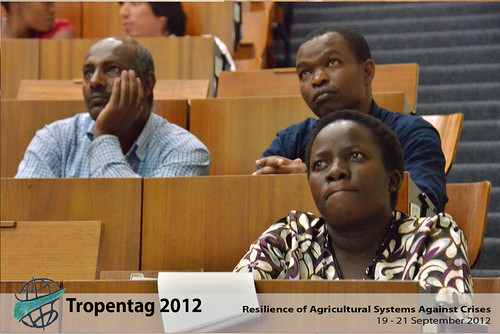
Tropentag 2012, Resilience of agricultural systems against crises

19–21 September 2012, Göttingen, Germany. The Tropentag is a development-oriented and interdisciplinary conference. It addresses issues of resource management, environment, agriculture, forestry, fisheries, food, nutrition and related sciences in the context of rural development, sustainable resource use and poverty alleviation worldwide.

The annual Conference on Tropical and Subtropical Agricultural and Natural Resource Management (TROPENTAG) is jointly organised by the universities of Bonn, Göttingen, Hohenheim, Kassel-Witzenhausen, Hamburg, Zurich as well as by the Council for Tropical and Subtropical Research (ATSAF e.V) in co-operation with the GIZ Advisory Service on Agricultural Research for Development (BEAF).

Tropentag 2012 was organised jointly by the faculty of agricultural sciences and the faculty of forestry of the Georg-August Universität Göttingen and the faculty of organic agricultural sciences of the University of Kassel. The conference venue will be in Göttingen, Germany. All students, Ph.D. students, scientists, extension workers, decision makers, politicians and practical farmers, interested and engaged in agricultural research and rural development in the tropics and subtropics are invited to participate and to contribute. 

Water and energy
Post-harvest technology
Food, health and nutrition

Modelling
Systems modelling
Systems modelling II

Development Cooperation
Soils and resilience (CIAT session)
Poetry route
Central issues on resilience of agricultural systems against crises (GIZ session) 


The Joint Learning in Innovation Systems in African Agriculture (JOLISAA) program, represented by Vincent Archiba Schmitt, shared recent experiences on innovation processes involving multiple stakeholders and types of knowledge.

Innovation Systems (IS) perspective inspires the framework of the JOLISAA research. IS stressed that the flow of technology and information among stakeholders is key to innovative processes. The project uses several avenues (inclusion/exclusion criteria, storyline, common underlying concepts, and iterative processes) to identify relevant innovations for deeper assessment and joint learning. JOLISSA lists selected innovations in three national inventories (BeninKenya, and South Africa).

Jointly, practitioners and researchers assess 13 cases from the existing national inventories. The key steps in this collaborative case assessments are: i) planning meetings, ii) focus group discussions, iii) multi-stakeholders feedback, and iv) literature review.

First findings of the study show that African innovation processes at smallholders level have the capacities to take advantage of opportunities, create markets, and manage natural resources. The project recommends long term support (min. 10 years) in dynamic, iterative and flexible manner adapted to specificities of context. This allows unfolding of multiple stakeholders processes and widespread impact of innovations in the African agricultural sector.

If you are interested and work on this topic, do not miss the international event JOLISAA will organize late may 2013, Kenya.

Proceedings
of the 2012 conference as PDF (2.3MB)

Tropentag 2013 will be held at the University of Hohenheim,
17 - 19 September 2013

Title: Agricultural development within the rural-urban continuum

Jumat, 14 Oktober 2011

German Marshall Fund of the United States launches Initiative to Strengthen Food Security in Africa

October 10, 2011. The German Marshall Fund recently launched the high-level Transformational Partnerships in Food Security in Africa: A Transatlantic Experts Group, whose American, European, and African members will identify and propose partnerships that drive positive change and lead to scalable food security programs, based on a shared vision among public and private sector actors. The group is co-chaired by GMF Senior Transatlantic Fellows Jim Kolbe and Jean-Michel Severino.

Click here to view all members of the Transatlantic Experts Group.

Under the guidance of the co-chairs and with input from group members, GMF will conduct consultations and hold workshops with government officials and experts in East Africa, the United States, and Europe to formulate recommendations on transformational partnerships to increase food security on a meaningful scale. At the group’s initial meetings in Brussels and Washington, members from think tanks, civil society, multilateral organizations, and government agencies, including The World Bank, USAID, UNDP, Wal-Mart, and the European Commission, debated the challenges and opportunities facing African food security partnerships and outlined an agenda for the coming months.

A final report will be released in Stockholm in early 2012, with shorter policy briefs and recommendations to be released in the interim.