Kamis, 06 Desember 2012

Finance for the Farmer around climate change

6 December 2012. Funding is always a prominent topic of discussion, and often a sensitive issue at such international gatherings as the UNFCCC COP18. Commitments made by member countries usually have some financial strings attached, and the question is largely ‘who will pay, how much, and for what?’ At Agriculture, Landscapes, and Livelihoods Day (ALL) the issue surfaced continuously over the course of the day – more money for technology transfer; more for neglected areas of research (climate impacts on pollination, pests, and disease); more for farmers. To manage overlapping objectives related to food security and nutrition, development, environment, and climate, there was undeniable agreement that increased and more efficient funding is necessary.

One Roundtable session at ALL Day honed in specifically on questions related to finance opportunities for smallholder farmers. This panel of private, government, and civil society experts attempted to cover all the bases, while still pulling from concrete case studies. The challenges identified by the panelists were telling about the key criteria for more integrated finance mechanisms.

CARE International Phil Franks (CARE International), in describing a smallholder carbon project in Kenya, noted how the value of the actual carbon revenue to each individual farmer is rather insignificant and the requirements to earn credits don’t allow for the level of flexibility farmers need to adapt. Initially touted as an innovative means to bring climate finance to farmers, smallholder carbon projects do in fact have benefits but largely in terms of soil fertility, water management, and productivity. For smallholder farmers, the dispersed nature of their holdings also makes it difficult to access carbon finance or insurance, due to high transaction costs.

Second from right: Matthew Wyatt (DFID)
Separation of adaptation and mitigation is one of the themes reiterated throughout the day, and a characteristic of the funding mechanisms within the UNFCCC. This split hinders implementing more integrated approaches to climate-smart land management. On the panel, Matthew Wyatt (DFID) noted  ow we need to get beyond this separation, because in agriculture the two go hand-in-hand. And yet funding, too, reflects this separation. Moreover, funding streams for climate change and agriculture and rural development also operate in their respective silos. One attempt to cross this divide, IFAD’s Adaptation for Smallholder Agriculture Programme (ASAP), is trying to blending climate and agriculture ‘know-how’ in financing resilient development for smallholders.

Lou Munden
So what does all this mean when we take a landscape perspective? Panelists were generally of one mind, emphasizing that operating on a landscape scale allows for more carbon storage while also increasing adaptive capacity. Lou Munden (Munden Project), representing the private sector on the panel, argued that “we need to stop thinking about how to make this fit old models and start thinking about new ones.” His company takes this to heart, focusing on investing in a diverse portfolio of activities within the landscape to manage risk.

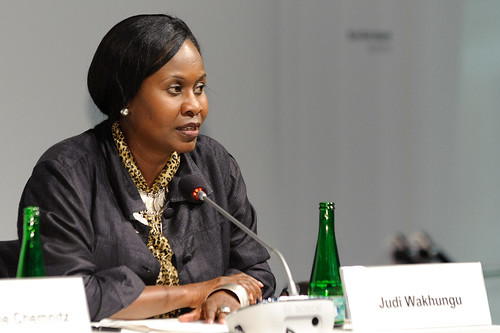
Judi Wakhungu
At the end of the day, though, the institutional structures in place are what will allow for better integration and efficiency for funding climate-smart landscapes. For example, in the opening panel of ALL Day, Judi Wakhungu (African Centre for Technological Studies) noted the restructuring of the Kenyan government and a proposal to integrate agriculture, environment, and climate change in one ministry.

A move such as this may help streamline funding for agricultural development that achieves multiple objectives and benefits to smallholders. As several panelists noted, public sector funding is crucial for covering the high upfront costs and reducing risks, which will in turn entice more private sector funding.

Related:
DOHA, Qatar December 6, 2012/ -- A new report by the African Development Bank, in collaboration with Vivid Economics, makes concrete proposals that will facilitate access by African countries to the Green Climate Fund.

Launched in Doha on the sidelines of the UN climate change conference (COP18), the “Getting Africa Ready for the Green Climate Fund” report makes a series of recommendations for the Green Climate Fund board and African nations that will increase the likelihood that African countries, with the support of the African Development Bank, will be able to access increased flows of climate finance from this source.

Doha: Agriculture, Landscapes and Livelihoods Day 5

3 December 2012. Doha, Qatar. “No agriculture, no deal” was the mantra coming out the fifth Agriculture, Landscapes, and Livelihoods (ALL, formerly Agriculture and Rural Development) Day on Monday. Yet it appears as though the Subsidiary Body on Scientific and Technological Advice (SBSTA) will not make any sort of recommendation regarding agriculture to the UNFCCC at COP18, due to difficulties in reaching consensus. And while according to Mahmoud Sohl (ICARDA), one of the speakers on the high level panel at ALL Day, “if they don’t put agriculture on the agenda, then they are not serious” about dealing with climate change, clearly participants at this year’s ALL Day felt strongly that agriculture needed to be part of the solution to climate change.

However, ALL Day also demonstrated that agriculture poses a unique challenge; there is such a diversity of interests, priorities, and stakeholders that underlie a more general agreement around issues and urgency. Whereas some like Sohl stressed a need for research into technology and sustainable intensification, others placed emphasis on institutions to strengthen gender considerations and integration of adaptation and mitigation.

African negotiators are concerned about the lack of 

trust at the Doha climate change talks. 
(Source: Flickr/UNFCCC)
A High-Level Panel that kick-started ALL Day reflected this diversity, composed of representatives in farming, research, and policy. But the session was not all about talking heads, as Dr. Lindiwe Majele Sibanda (CEO, FANRPAN) called 0n the audience for feedback and questions. Through the farmers who voiced their concerns and opinions, it became increasingly apparent that these stakeholders felt as though their experiences and hurdles with climate change were not being heard in high-level policy.

The challenge for the agriculture community within UNFCCC processes is to find a unifying voice. As Dr. Sibanda said during the opening panel, “let’s all speak with one voice – it’s all about the food.” And regardless of whether or not something comes to fruition at COP18 or beyond, the message is clear that all of these different voices – particularly those without much access – need to come to the table to deal with climate change in a context-specific and meaningful manner.

Swaziland’s Dr Emmanuel Dlamini, Director of Meteorology, said there was a mismatch between what some richer nations had promised and what they were prepared to put on the table in Doha.

Many developed parties, including Norway, Japan and the EU, have met or exceeded their targets for FSF, which promised a total of $30bn from 2010-2012. The EU insists that there is money budgeted for support to continue and RTCC understands that the US also intends to maintain its climate finance at current levels.
However, African countries would prefer to see more concrete pledges.

“They are saying ‘we’ll continue with FSF, there’ll be no cliff, well keep providing funds’, so it’s difficult when we ask for a [formal] decision and they say they are just giving assurances. So you start saying are we negotiating in good faith?”
“The negotiations greatest challenge is building trust. To a certain extent, the trust that is there, if it is there [at all], is not sufficient enough to make us agree to make a successful outcome. When there is no trust among people then the good faith is damaged,” added Dlamini.

EU negotiator Artur Runge-Metzger insists the bloc will continue to provide climate finance beyond 2012

Related:
With the climate talks in Doha in their second week, Kenya like many African countries is pessimistic that any concrete decisions will be reached at the ongoing negotiations. However Kenya says it is willing to continue working with other African countries to fight for the continent's concerns even as the negotiations time the last lap. NTV's Loise Wangui reports on the talks.

IFDC 2013 International Training Calendar

IFDC has held over 700 formal workshops, study tours and training programs for more than 10,000 participants from 150 countries since 1974. The programs have covered a wide range of subjects including integrated soil fertility management, fertilizer use efficiency, fertilizer production technology, agro-input dealerships, competitive marketing, supply chain management, investment analysis, policy reforms and numerous specialized topics.

Please visit the IFDC ebsite for additional information, updates and registration forms for the IFDC 2013 Training Program Calendar. 
  1. Developing Private Sector Agro-Input Markets: Designing and Implementing Targeted Input Subsidies April 8-12, 2013 Nairobi, Kenya $1,300 
  2. Fertilizer Policy & Marketing Strategies in Africa ; May 20-24, 2013 Arusha, Tanzania $1,300 
  3. Linking Farmers to Markets in Africa ; July 1-5, 2013 Nairobi, Kenya $1,300 
  4. Developing and Managing Profitable Agro-Input Business Through Sustainable Value Chains ; ovember 4-8, 2013 Ouagadougou, Burkina Faso $1,300 
IFDC reserves the right to cancel any program or change the dates and/or venue of any program without liability for compensation.For the PDF printable version of our calendar, please click here.

The Future of Agriculture: Debate the Experts @ OXFAM


Monday, December 10, 2012 - Friday, December 21, 2012
Online: blogs.oxfam.org/future-of-agriculture
Forecasts indicate world food production must grow at least fifty per cent by 2050, to feed a population of nine billion people. Can this be done in a way that eradicates hunger and preserves the environment? 
The second in Oxfam’s online discussion series will tackle this very question from Monday, December 10 to Friday December 21, at blogs.oxfam.org/future-of-agriculture.

Biotechnology and Africa’s Strategic Interests

3 December 2012. In this opinion piece, Calestous Juma, a professor of international development at Harvard University, United States, writes that while threats to global food security are increasingly evident, efforts to stall adoption of new technologies are appearing to intensify. A lack of strategic thinking about food as a national security issue is leading many African countries, Juma says, to make poor decisions regarding agricultural biotechnology. 
Juma writes: “Africa’s precautionary approaches to biotechnology are not only misguided but they expose the continent to long-term political risks. The issue is no longer a simplistic argument about becoming an importer of GM foods; it is about building up the requisite capacity to diversify the technological options needed for long-term agricultural adaptation. Biotechnology offers Africa a wider range of economic opportunities than the Green Revolution did. It is already being used to improve food production and establish or revive cotton production. Its economic impact is therefore likely to go well beyond the farm sector to include industrial development.” 
Agricultural biotechnology is already being used in numerous countries around the globe, providing new opportunities for African countries to create trading alliances, and potentially new technology partnerships. Juma argues that African leaders should appoint chief science and technology advisors that can provide strategic advice about these issues. 
“Guided by good science and technology advice, the choices open to African leaders are clear,” says Juma. “Doing nothing, especially in an age of worsening food prospects, is no longer an option. The time has come for African nations to start focusing on their long-term strategic interests. Biotechnology is not simply a matter of rhetorical debate guided by short-term interests. It is central to how African countries define their place in the global knowledge ecology.” 

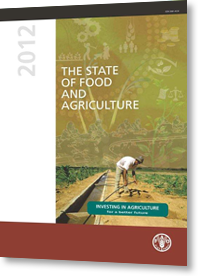
The State of Food and Agriculture 2012

6 December 2012, Rome Investing in agriculture for a better future
Investing in agriculture is essential for reducing hunger and promoting sustainable agricultural production. Those parts of the world where agricultural capital per worker and public investments in agriculture have stagnated are the epicentres of poverty and hunger today. Demand growth over the coming decades will place increasing pressure on the natural resource base. Eradicating hunger sustainably will require a significant increase in agricultural investments, but also an improvement in their effectiveness.

Farmers are the largest investors in developing country agriculture and must be central to any strategy for increasing investment in the sector, but if they are to invest more in agriculture they need a favourable climate for agricultural investment based on economic incentives and an enabling environment. 

Governments also have a special responsibility to help smallholders overcome the constraints they face in expanding their productive assets and to ensure that large-scale investments in agriculture are socially beneficial and environmentally sustainable. Government investment in agriculture is a crucial component of providing an enabling environment for private investments in the sector. Governments need to channel scarce public funds towards the provision of essential public goods with high economic and social returns.

Read the executive summary
Download the full publication
See the press release

Senin, 03 Desember 2012

Food Security in Africa: Bridging Research and Practice

29-30 November 2012. Sydney. This event included a high-level Forum (leadership dialogue) for officials from Africa and Australia, together with international experts on global food security. The main purpose of the Forum was to officially launch the Australian International Food Security Centre (AIFSC) and strengthen its collaborative partnerships.

The Forum brought together a selection of notable high-level Africans, Australians and internationals from government, research and development, and private enterprise to:
  • launch the AIFSC strategy and acknowledge the range of national and international partnerships
  • enable discussion to inform the AIFSC strategy outcomes for improving food security across Africa
  • showcase Australia's expertise in research for development and policy development for improved global food security
  • showcase Australia's quality agriculture through a short social program.
The Hon Bob Carr, Minister for Foreign 
Affairs, announcing the new fund 
at the opening of the forum. 
Photo M Gyles ACIAR
The conference provided an opportunity for:
  • networking with key African and international decision makers
  • fostering new connections with Australian researchers and the AIFSC
  • contributing ideas that will be streamed/recorded for wider distribution
  • improving your personal knowledge on key issues and players involved in food security
  • connecting with a large number of international representatives at one event, away from everyday distractions and time zone issues
  • being part of conference legacies to be generated by distribution of conference records to multiple organisations
  • side meetings for one-on-one business with a special focus
  • witnessing firsthand some of Australia’s finest agricultural research capabilities
  • enjoying the dramatic beauty of Sydney and its surrounds, including a showcase of Australian agriculture.