Tampilkan postingan dengan label climate change. Tampilkan semua postingan

Rabu, 20 Februari 2013

Call for proposals from the The Climate Change Adaptation in Africa

The Climate Change Adaptation in Africa (CCAA) program is a joint initiative of the UK’s Department for International Development (DFID) and IDRC that concluded in 2012. Over the course of the program, from 2006-2012, researchers in 33 African countries produced a wealth of new knowledge on climate change adaptation.

CCAA interactive report: New Pathways to Resilience
IDRC documents the CCAA story in an interactive report, New Pathways to Resilience. The report provides a guided tour of the program’s aims, efforts, and chief contributions. Throughout the report, you will find links to program and project resources, and directions for delving further into its scientific findings.

IDRC and DFID launch a new program on climate change adaptation
IDRC and the UK’s Department for International Development (DFID) are funding a new program on climate change adaptation. The Collaborative Adaptation Research Initiative in Africa and Asia (CARIAA) began in 2012 and will run until 2019.

CARIAA invites submissions of joint concept notes for the establishment of research consortia in three climate change hot spots: semi-arid regions, deltas, and glacier and snowpack dependent river basins. Find out what we’re looking for and how you can apply by reading the call documents and Frequently Asked Questions on their website.

The call for concept notes on collaborative adaptation research in three hot spots is open until April 4, 2013.

Jumat, 15 Februari 2013

Africa Adaptation Knowledge Network (AAKNET) Workshop

5 - 6 February 2013. UNEP headquarters , Nairobi. Africa Adaptation Knowledge Network (AAKNET) Workshop. This workshop was convened under the theme "Convening Adaptation Knowledge Networks and Platforms in Africa".

The Africa Adaptation Knowledge Network is facilitated by UNEP under the umbrella of the Global Adaptation Network (GAN).

Around 70 representatives from some 20 regional adaptation knowledge platforms and others organizations together endorsed the Africa Adaptation Knowledge Network (AAKNet) as the continental network to be responsible for coordinating, facilitating, harnessing and strengthening the exchange of information and knowledge and fostering and supporting strategic planning and policy processes.


The Network functions as a knowledge hub on adaptation, promoting cooperation and collaboration in seeking robust solutions to climate change impacts using experiences and lessons learnt from the implementation of independent actions in different locations. It also seeks to convene existing adaptation knowledge networks and platforms in Africa to open a window of opportunity for taking stock of the state of adaptation knowledge mobilization on the continent.

The AAKNet website is available at: www.africa.ganadapt.org

PARTNERS

UNEP   Global Adaptation NetworK    cdkn               REGATTA  CCDARE project

Related:


The AfriCAN Climate Project

AfriCAN Climate is a project co-funded by the European Commission within the 7th FRAMEWORK PROGRAMME. The project was set up by a team of 5 African and 5 European organisations, including research institutes and networks, and runs from October 2011 to September 2014.

The AfriCAN Climate Portal

The AfriCAN Climate Portal is an innovative web-based knowledge platform for the sharing of climate change research and good practices. The portal employs innovative and creative web functionalities to harmonise multilingual, interdisciplinary and pan-continental climate change knowledge and to encourage project developers and stakeholders to learn and benefit from Africa’s challenges and success stories.

The AfriCAN Consortium


The European-African project consortium brings in high profile expertise to cover all thematic climate change research and action areas: Adaption and mitigation research, future climate scenarios, climate policy, applied research in good practices and climate project financing. The consortium gathers the following 10 organisations:

Project coordinator:
WIP Renewable Energies Munich, Germany

Project partners:
Africa: 
  1. ENDA Tiers Monde Dakar, Senegal
  2. FANRPAN - The Food, Agriculture and Natural Resources Policy Analysis Network of Southern Africa Pretoria, South Africa
  3. University of the Witwatersrand Johannesburg, South Africa
  4. World Agroforestry Centre Nairobi, Kenya
  5. ICPAC - IGAD Climate Prediction and Application Centre Nairobi, Kenya
Europe:
  1. Imperial College London, United Kingdom
  2. P.A.U. Education Barcelona, Spain
  3. Technical University of Denmark / UNEP Risoe Centre Roskilde, Denmark
  4. Practical Action Rugby, United Kingdom

Rabu, 12 Desember 2012

DFID, IDRC Introduce Collaborative Adaptation Research Initiative in Africa and Asia at COP 18


2 December 2012. Doha, Qatar. In partnership with the UK’s Department for International Development (DFID), Canada’s International Development Research Center (IDRC) hosted a parallel event to the 18th session of the Conference of the Parties (COP 18) to the UNFCCC that introduced the new Collaborative Adaptation Research Initiative in Africa and Asia (CARIAA).
Isabelle Proulx, CARIAA Team

Through interactive sessions, facilitated by Alexander Alusa, Climate Change Advisor to the Prime Minister of Kenya, participants discussed the CARIAA model and its approach and application, in anticipation of CARIAA’s open call for consortia to be launched in early 2013.

CARIAA is a US$70 million programme, initiated by DFID and IDRC, that will run from 2012 to 2019. It aims to increase the resilience of vulnerable populations and their livelihoods, in one of the following climate change “hot spots” in Africa and Asia: densely populated river basins, large deltas, and semi-arid regions. The experience and lessons learned through the Climate Change Adaptation in Africa programme (2006-2012), DFID’s and IDRC’s earlier joint climate change effort, have provided insight and guidance for CARIAA’s mission.

During the event in Doha, Qatar, Isabelle Proulx, CARIAA Team, introduced the programme, highlighting that the target areas, large deltas, glacier-fed river basins and semi-arid zones, have been chosen because of their vulnerabilities to climate change. She noted that CARIAA’s strategy is to create knowledge and put it in the hands of the people that are affected by climate change. Proulx noted that three interdisciplinary consortia, which will have up to five members, would be funded and expected to draw from a large base of institutions, and to engage communities. She underlined that the expectations are that the funded projects will promote research uptake and generate new knowledge.
[CARIAA website]

UNEP Launches the Africa Adaptation Knowledge Network

6 December 2012: The UN Environment Programme (UNEP) has launched the Africa Adaptation Knowledge Network (AAKNet), which will provide a platform to share knowledge, research and information on initiatives, as well as catalyze partnerships for climate change adaptation.

The network builds on efforts to mobilize knowledge and provide solutions to mitigate the impact of climate change on livelihoods in Africa. Specifically, AAKNet will: conduct workshops to provide advice and share knowledge on climate change adaptation to local communities; build partnerships to support climate change responses; share best practices and lessons learned from numerous initiatives across the continent; and aggregate knowledge to address climate risks.

AAKNet will share information and aid in building a community of practice to aid in planning processes on the continent and scale-up successful initiatives to adapt to climate change. [UN Press Release] [Africa Adaptation Knowledge Network Website]

Kamis, 06 Desember 2012

Finance for the Farmer around climate change

6 December 2012. Funding is always a prominent topic of discussion, and often a sensitive issue at such international gatherings as the UNFCCC COP18. Commitments made by member countries usually have some financial strings attached, and the question is largely ‘who will pay, how much, and for what?’ At Agriculture, Landscapes, and Livelihoods Day (ALL) the issue surfaced continuously over the course of the day – more money for technology transfer; more for neglected areas of research (climate impacts on pollination, pests, and disease); more for farmers. To manage overlapping objectives related to food security and nutrition, development, environment, and climate, there was undeniable agreement that increased and more efficient funding is necessary.

One Roundtable session at ALL Day honed in specifically on questions related to finance opportunities for smallholder farmers. This panel of private, government, and civil society experts attempted to cover all the bases, while still pulling from concrete case studies. The challenges identified by the panelists were telling about the key criteria for more integrated finance mechanisms.

CARE International Phil Franks (CARE International), in describing a smallholder carbon project in Kenya, noted how the value of the actual carbon revenue to each individual farmer is rather insignificant and the requirements to earn credits don’t allow for the level of flexibility farmers need to adapt. Initially touted as an innovative means to bring climate finance to farmers, smallholder carbon projects do in fact have benefits but largely in terms of soil fertility, water management, and productivity. For smallholder farmers, the dispersed nature of their holdings also makes it difficult to access carbon finance or insurance, due to high transaction costs.

Second from right: Matthew Wyatt (DFID)
Separation of adaptation and mitigation is one of the themes reiterated throughout the day, and a characteristic of the funding mechanisms within the UNFCCC. This split hinders implementing more integrated approaches to climate-smart land management. On the panel, Matthew Wyatt (DFID) noted  ow we need to get beyond this separation, because in agriculture the two go hand-in-hand. And yet funding, too, reflects this separation. Moreover, funding streams for climate change and agriculture and rural development also operate in their respective silos. One attempt to cross this divide, IFAD’s Adaptation for Smallholder Agriculture Programme (ASAP), is trying to blending climate and agriculture ‘know-how’ in financing resilient development for smallholders.

Lou Munden
So what does all this mean when we take a landscape perspective? Panelists were generally of one mind, emphasizing that operating on a landscape scale allows for more carbon storage while also increasing adaptive capacity. Lou Munden (Munden Project), representing the private sector on the panel, argued that “we need to stop thinking about how to make this fit old models and start thinking about new ones.” His company takes this to heart, focusing on investing in a diverse portfolio of activities within the landscape to manage risk.

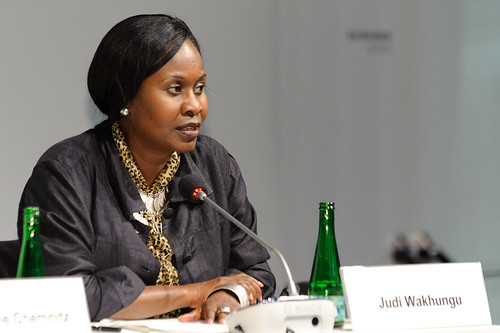
Judi Wakhungu
At the end of the day, though, the institutional structures in place are what will allow for better integration and efficiency for funding climate-smart landscapes. For example, in the opening panel of ALL Day, Judi Wakhungu (African Centre for Technological Studies) noted the restructuring of the Kenyan government and a proposal to integrate agriculture, environment, and climate change in one ministry.

A move such as this may help streamline funding for agricultural development that achieves multiple objectives and benefits to smallholders. As several panelists noted, public sector funding is crucial for covering the high upfront costs and reducing risks, which will in turn entice more private sector funding.

Related:
DOHA, Qatar December 6, 2012/ -- A new report by the African Development Bank, in collaboration with Vivid Economics, makes concrete proposals that will facilitate access by African countries to the Green Climate Fund.

Launched in Doha on the sidelines of the UN climate change conference (COP18), the “Getting Africa Ready for the Green Climate Fund” report makes a series of recommendations for the Green Climate Fund board and African nations that will increase the likelihood that African countries, with the support of the African Development Bank, will be able to access increased flows of climate finance from this source.

Doha: Agriculture, Landscapes and Livelihoods Day 5

3 December 2012. Doha, Qatar. “No agriculture, no deal” was the mantra coming out the fifth Agriculture, Landscapes, and Livelihoods (ALL, formerly Agriculture and Rural Development) Day on Monday. Yet it appears as though the Subsidiary Body on Scientific and Technological Advice (SBSTA) will not make any sort of recommendation regarding agriculture to the UNFCCC at COP18, due to difficulties in reaching consensus. And while according to Mahmoud Sohl (ICARDA), one of the speakers on the high level panel at ALL Day, “if they don’t put agriculture on the agenda, then they are not serious” about dealing with climate change, clearly participants at this year’s ALL Day felt strongly that agriculture needed to be part of the solution to climate change.

However, ALL Day also demonstrated that agriculture poses a unique challenge; there is such a diversity of interests, priorities, and stakeholders that underlie a more general agreement around issues and urgency. Whereas some like Sohl stressed a need for research into technology and sustainable intensification, others placed emphasis on institutions to strengthen gender considerations and integration of adaptation and mitigation.

African negotiators are concerned about the lack of 

trust at the Doha climate change talks. 
(Source: Flickr/UNFCCC)
A High-Level Panel that kick-started ALL Day reflected this diversity, composed of representatives in farming, research, and policy. But the session was not all about talking heads, as Dr. Lindiwe Majele Sibanda (CEO, FANRPAN) called 0n the audience for feedback and questions. Through the farmers who voiced their concerns and opinions, it became increasingly apparent that these stakeholders felt as though their experiences and hurdles with climate change were not being heard in high-level policy.

The challenge for the agriculture community within UNFCCC processes is to find a unifying voice. As Dr. Sibanda said during the opening panel, “let’s all speak with one voice – it’s all about the food.” And regardless of whether or not something comes to fruition at COP18 or beyond, the message is clear that all of these different voices – particularly those without much access – need to come to the table to deal with climate change in a context-specific and meaningful manner.

Swaziland’s Dr Emmanuel Dlamini, Director of Meteorology, said there was a mismatch between what some richer nations had promised and what they were prepared to put on the table in Doha.

Many developed parties, including Norway, Japan and the EU, have met or exceeded their targets for FSF, which promised a total of $30bn from 2010-2012. The EU insists that there is money budgeted for support to continue and RTCC understands that the US also intends to maintain its climate finance at current levels.
However, African countries would prefer to see more concrete pledges.

“They are saying ‘we’ll continue with FSF, there’ll be no cliff, well keep providing funds’, so it’s difficult when we ask for a [formal] decision and they say they are just giving assurances. So you start saying are we negotiating in good faith?”
“The negotiations greatest challenge is building trust. To a certain extent, the trust that is there, if it is there [at all], is not sufficient enough to make us agree to make a successful outcome. When there is no trust among people then the good faith is damaged,” added Dlamini.

EU negotiator Artur Runge-Metzger insists the bloc will continue to provide climate finance beyond 2012

Related:
With the climate talks in Doha in their second week, Kenya like many African countries is pessimistic that any concrete decisions will be reached at the ongoing negotiations. However Kenya says it is willing to continue working with other African countries to fight for the continent's concerns even as the negotiations time the last lap. NTV's Loise Wangui reports on the talks.

Jumat, 23 November 2012

Mitigation Potentials In The Livestock Sector

13 November, 2012. The CGIAR Research Program on Climate Change, Agriculture and Food Security (CCAFS) live streamed Dr. Mario Herrero, Senior agro-ecological systems analyst at the International Livestock Research Institute (ILRI). The science seminar covered the topic of mitigation potentials in the livestock sector, which was followed by a 30 minute interactive discussion session.


Selasa, 02 Oktober 2012

The Kenya Climate Innovation Center (CIC).

26 September 2012. The World Bank will provide US$15 million over the next five years to the Kenya Climate Innovation Center (CIC). The Kenya CIC is expected to support approximately 70 sustainable climate technology business enterprises within its first five years and is projected to create over 24,000 jobs over ten years.

Through offering financial and other services to climate entrepreneurs, the climate innovation center will facilitate Kenya in reaching several of its environmental goals, including the promotion of clean energy, locally-developed products like high efficiency stoves.

These include reduced CO2 emissions, increased climate adaptation and resilience, and access to clean energy and water. In addition to environmental achievements, the center is also expected to promote economic and social objectives.

Kenneth Ndua, founder of start-up Fawandu, is an entrepreneur who is developing a domestically produced, high-efficiency stove that simultaneously cooks and sanitizes water through boiling.
“I want to provide clean water and cooking to 24,000 households, and create 550 jobs, 400 of which will be for women. The support of the CIC would help me to commercialize and rollout of our products at the national level,” he says.
The CIC is supported by the World Bank’s infoDev in partnership with the government of Denmark and the Britain’s UKAid. The CIC is an innovative model to accelerate locally owned, locally developed solutions to climate change. In addition to reducing greenhouse gas emissions and improving climate resiliency, it will accelerate business in high-growth sectors such as renewable energy, agriculture, clean water, and energy efficiency. 
Cook Stove in Kenya, a local solution to a global problem 

Senin, 01 Oktober 2012

FaRMAf - Innovative new project to improve food security in Africa


26 et 27 septembre. Ouagadougou. Le projet FARMAF financé par l'UE, qui porte sur la gestion des risques agricoles en Afrique, a été lancé. Le projet vise à améliorer la sécurité alimentaire et les moyens de subsistance des producteurs agricoles familiaux en Afrique, en renforçant leur accès aux outils de gestion des risques agricoles.

L'atelier de lancement a mis en évidence le fait que la capacité des agriculteurs à anticiper, éviter et répondre aux chocs naturels et économiques était cruciale pour la réduction de la pauvreté et de la sécurité alimentaire en milieu rural. Toutefois, les agriculteurs africains, et les producteurs familiaux en particulier, manquent souvent d'accès à des outils et sont donc directement confrontés aux risques pré- et post- récoltes. Le projet FARMAF vise à renforcer l'accès des producteurs agricoles familiaux à ces outils. Ce faisant, FARMAF contribue à améliorer de façon durable les moyens de subsistance des agriculteurs en Afrique.

Au cours de l'atelier de lancement du projet FARMAF, les expériences du Burkina Faso, de la Tanzanie et de la Zambie ont été présentées et discutées, ce qui a permis de mettre en lumière le fonctionnement de différents outils (assurance, systèmes d'information sur le marché, warrantage et action collective).

Des suggestions ont été faites sur la façon dont ceux-ci peuvent être améliorés et renforcés grâce à la participation des organisations régionales de producteurs agricoles (PAFO, ROPPA, EAFF, SACAU et PROPAC), et des organisations nationales de producteurs agricoles (MWIWATA, CPF et ZNFU) et à la collaboration des instituts de recherche Agrinatura (CIRAD, NRI et WUR).
Selon le représentant de la Plateforme continentale des organisations paysannes (PAFO), Kolyang Palébélé, ce projet vise « à améliorer l’accès des producteurs agricoles aux outils de gestion des risques de manière efficace contribuant ainsi à l’amélioration de la sécurité alimentaire familiale et des revenus des ménages ruraux les plus pauvres ». Comme outils de gestion, il s’agit principalement des systèmes d’assurance agricole, de warrantage et d’informations de marché, a indiqué M. Palébélé.
De son avis, ces outils ont été développés avec succès dans certains pays africains car ayant permis aux producteurs d’accéder à des mécanismes de crédit en milieu rural, à des systèmes de commercialisation plus efficace et d’obtenir des prix rémunérateurs.
Financé par l’union européenne, la FARMAF est mis en Å“uvre pour compenser les pertes liées aux conditions climatiques, a ajouté le président de la Confédération paysanne du Faso (CPF), Bassiaka Dao. Pour réaliser ses objectifs, le projet cherche à accroître l’éventail d’outils et d’instrument durables que les petits exploitants des pays africains peuvent utiliser pour gérer les risques agricoles.
Ceci devra réduire leur exposition aux chocs baissiers, améliorer leur accès au crédit et leurs capacités à investir dans une technologie améliorant le rendement et à mieux gérer la commercialisation des produits de la ferme, a précisé le représentant de Agrinatura, Paolo Sarfatti.
Lire l'article : La FARMAF, un projet de gestion des risques agricoles en Afrique - Burkinapmepmi.com - le portail des PME / PMI au Burkina Faso

Climate change, agriculture and food security

27 September, 2012. The latest Brussels Development Briefing focused on ‘Climate change, agriculture and food security: proven approaches and new investments’.

It addressed issues related to agriculture and food security in a changing climate, and how agriculture can increase resilience to climate change effects.

The briefing, was organized in collaboration with the CGIAR Research Program on Climate Change, Agriculture and Food Security (CCAFS). Around 180 ACP-EU policy-makers and representatives of EU Member States, civil society groups, research networks and development practitioners, and international organizations based in Brussels, attended the event.

Programme
Webstreaming
Reader

Panel 1: Agriculture, food security and climate change: What’s new?
This panel presented the key concepts, challenges and opportunities for agriculture and food security in relation to climate change. It gave an overview of the international negotiations on climate change and how they feature agriculture, especially in the context of ACP countries, and the farmers’ perspective on how progress can best be achieved. It included an overview of climate finance for agriculture that is relevant to ACP countries.
  • Smallholder agriculture under climate change: challenges and outlookSonja Vermeulen, Head of Research, CGIAR Research Program on Climate Change, Agriculture and Food Security (CCAFS)
  • The status of agriculture in negotiations on climate change: update and outlook [Presentation]Anette Friis, Manager, Climate Change Policy, Danish Agriculture & Food Council, Member of World Farmer’s Organisation
  • Planning for climate-smart landscapes [Presentation] [Summary]Tony Simons, Director General of the World Agroforestry Centre (ICRAF)
  • View from ACP farmers: successes to date and needs for the future [Presentation]Ishmael Sunga, CEO, The Southern African Confederation of Agricultural Unions (SACAU)
  • Leveraging finance for climate-smart agriculture: overview of funding mechanisms relevant to ACP countries [Presentation][Summary] Charlotte Streck, Director of Climate Focus and former Senior Counsel with the World Bank, USA
Panel 2: Opportunities and innovations to bring climate-smart agriculture to scale
This panel presented a set of proven innovations to deliver climate-smart agriculture. It presented climate-smart interventions that work – socially, economically and environmentally – and could be scaled up in ACP agricultural and food systems.
  • Scaling-up the implementation of climate-smart agriculture: innovations and successes [Presentation]Arslan, Aslihan, Natural Resource Economist , the Agricultural Development Division FAO
  • Small sized holdings and low value crops: the case of index-based insurance [Presentation]Kolli N. Rao, Chief Risk Officer, Agricultural Insurance Company of India
  • Integrated national and regional approaches to climate-smart agriculture in the Caribbean [Presentation] [Summary]Carlos Fuller, Expert, Caribbean Community Climate Change Centre (CCCCC)
  • Successes in climate adaptation and mitigation in the Pacific region [Presentation] [Summary] Taito Nakalevu, Project Manager, Pacific Adaptation to Climate Change (PACC), SPREP
  • How farmers are linking food security, adaptation and mitigation in East Africa [Presentation] [Summary] Moses Tenywa, Director of Makerere University Agricultural Research Institute, Uganda

Rabu, 26 September 2012

16th International Symposium of the International Society for Tuber & Root Crops

23 - 28 September 2012. University of Agriculture, Abeokuta (UNAAB), Ogun State, Nigeria. 

The theme of the event was “The Roots and Tubers of Development and Climate Change”. Tropical roots and tuber crops are essential to meeting global food security needs, improving staple foods of world's poor and creating new opportunities in global food supply.  The symposium gathered about 200 scientists from over 30 countries willing to share experiences, build collaborations and develop strategies to contribute to sustainable root and tuber development.

Subthemes:
  • Policies favourable to enhancing the contribution of RTCs to development- (1) poverty reduction and food security (2) enterprise development and income generation and export development, (3) impacts of climate change and variability, (4) impacts of the global food crisis, global economic downturn and urbanization, (5) opportunities provided by biofuels. (6) Intellectual Property Rights
  • Global Scenario on Production, Utilization and Marketing of Root and Tuber Crops - Trade and Technology Commercialization; 
  • Progress in the science and technology for enhancing the contribution of Tropical Root Crops to development - Crop Improvement and Genomics; Biodiversity, Conservation and Evaluation; Biotechnology and Biofortification; Characterization of resistance to biotic and abiotic stressors; Plant, Water and Nutrient Management
  • Applying new scientific and technical knowledge on RTCs to contribute to development.- Technology Development and Transfer processes and systems; Value Addition for Food, Nutrition and Health; Regional Exchanges and Technology Transfer; Roots and Tubers for Feed and manure.

Second Global Conference on Agriculture, Food Security and Climate Change


3-7 September 2012.
Hanoi, Vietnam. The Second Global Conference on Agriculture, Food Security and Climate Change co-organized by Viet Nam and the Netherlands, in close collaboration with other partners, including FAO and the World Bank looked at strategies and practices that can take this comprehensive approach. 

The opening ceremony of the 2nd global conference on agriculture,
food security and climate change, September 6, 2012
The conference allowed global leaders, practitioners, private sector, scientists, and civil society to share experiences and demonstrate how early action on Climate-Smart Agriculture (CSA) can act as a driver of green growth. 

It was also be an opportunity to take stock of implementation of CSA since the First Global Conference in November 2010.

Africa-related presentations:
  • Yaya Adisa Olatan Olaniran, Chair of the Committee on World Food Security (Download PDF ) 
  • Smallholder farmer response to climate change: perspective and priorities for CSA adoption: Dyborn Chibonga (World Farmers Organization) (Download PDF ) 
  • Malawi CSA national implementation: Wilfred G. Lipita (Malawi) (Download PDF ) 
  • Agriculture, Food Security and Climate Change: Mary Karanja, Assistant Director, Ministry of Agriculture, Kenya (Download PDF ) 
  • Elements of an integrated approach, for landscape management: Nurudin Chamya, Coordinator, National Forestry Resources Monitoring and Assessment, Tanzania (Download PDF ) 
  • Sustainable land management and climate smart agriculture in Ethiopia: Melaku Tadesse National Coordinator, Sustainable Land Management Program. Ethiopia (Download PDF ) 
  • The role of Policy in Agricutural Production and Climate Change Adaption: Evelyn Anmubiru-Mwaura, AGRA (Download PDF )