Kamis, 06 Desember 2012

The Future of Agriculture: Debate the Experts @ OXFAM


Monday, December 10, 2012 - Friday, December 21, 2012
Online: blogs.oxfam.org/future-of-agriculture
Forecasts indicate world food production must grow at least fifty per cent by 2050, to feed a population of nine billion people. Can this be done in a way that eradicates hunger and preserves the environment? 
The second in Oxfam’s online discussion series will tackle this very question from Monday, December 10 to Friday December 21, at blogs.oxfam.org/future-of-agriculture.

Biotechnology and Africa’s Strategic Interests

3 December 2012. In this opinion piece, Calestous Juma, a professor of international development at Harvard University, United States, writes that while threats to global food security are increasingly evident, efforts to stall adoption of new technologies are appearing to intensify. A lack of strategic thinking about food as a national security issue is leading many African countries, Juma says, to make poor decisions regarding agricultural biotechnology. 
Juma writes: “Africa’s precautionary approaches to biotechnology are not only misguided but they expose the continent to long-term political risks. The issue is no longer a simplistic argument about becoming an importer of GM foods; it is about building up the requisite capacity to diversify the technological options needed for long-term agricultural adaptation. Biotechnology offers Africa a wider range of economic opportunities than the Green Revolution did. It is already being used to improve food production and establish or revive cotton production. Its economic impact is therefore likely to go well beyond the farm sector to include industrial development.” 
Agricultural biotechnology is already being used in numerous countries around the globe, providing new opportunities for African countries to create trading alliances, and potentially new technology partnerships. Juma argues that African leaders should appoint chief science and technology advisors that can provide strategic advice about these issues. 
“Guided by good science and technology advice, the choices open to African leaders are clear,” says Juma. “Doing nothing, especially in an age of worsening food prospects, is no longer an option. The time has come for African nations to start focusing on their long-term strategic interests. Biotechnology is not simply a matter of rhetorical debate guided by short-term interests. It is central to how African countries define their place in the global knowledge ecology.” 

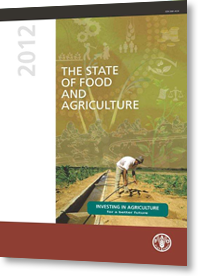
The State of Food and Agriculture 2012

6 December 2012, Rome Investing in agriculture for a better future
Investing in agriculture is essential for reducing hunger and promoting sustainable agricultural production. Those parts of the world where agricultural capital per worker and public investments in agriculture have stagnated are the epicentres of poverty and hunger today. Demand growth over the coming decades will place increasing pressure on the natural resource base. Eradicating hunger sustainably will require a significant increase in agricultural investments, but also an improvement in their effectiveness.

Farmers are the largest investors in developing country agriculture and must be central to any strategy for increasing investment in the sector, but if they are to invest more in agriculture they need a favourable climate for agricultural investment based on economic incentives and an enabling environment. 

Governments also have a special responsibility to help smallholders overcome the constraints they face in expanding their productive assets and to ensure that large-scale investments in agriculture are socially beneficial and environmentally sustainable. Government investment in agriculture is a crucial component of providing an enabling environment for private investments in the sector. Governments need to channel scarce public funds towards the provision of essential public goods with high economic and social returns.

Read the executive summary
Download the full publication
See the press release

Senin, 03 Desember 2012

Food Security in Africa: Bridging Research and Practice

29-30 November 2012. Sydney. This event included a high-level Forum (leadership dialogue) for officials from Africa and Australia, together with international experts on global food security. The main purpose of the Forum was to officially launch the Australian International Food Security Centre (AIFSC) and strengthen its collaborative partnerships.

The Forum brought together a selection of notable high-level Africans, Australians and internationals from government, research and development, and private enterprise to:
  • launch the AIFSC strategy and acknowledge the range of national and international partnerships
  • enable discussion to inform the AIFSC strategy outcomes for improving food security across Africa
  • showcase Australia's expertise in research for development and policy development for improved global food security
  • showcase Australia's quality agriculture through a short social program.
The Hon Bob Carr, Minister for Foreign 
Affairs, announcing the new fund 
at the opening of the forum. 
Photo M Gyles ACIAR
The conference provided an opportunity for:
  • networking with key African and international decision makers
  • fostering new connections with Australian researchers and the AIFSC
  • contributing ideas that will be streamed/recorded for wider distribution
  • improving your personal knowledge on key issues and players involved in food security
  • connecting with a large number of international representatives at one event, away from everyday distractions and time zone issues
  • being part of conference legacies to be generated by distribution of conference records to multiple organisations
  • side meetings for one-on-one business with a special focus
  • witnessing firsthand some of Australia’s finest agricultural research capabilities
  • enjoying the dramatic beauty of Sydney and its surrounds, including a showcase of Australian agriculture.

Green Economy – from intention to action

Tony Simons (far right) speaking at the SusCon in Bonn
27-28 November 2012, Bonn. SusCon 2012. For the third time SusCon, the International Conference on Sustainable Business and Consumption.

The conference brought - under the patronage of Mr. Janez Potočnik, European Commissioner for the Environment together - around 450 participants from 37 countries. Businesses, NGOs and politicians discussed on issues related to a “Green Economy” and debated on solutions for sustainable supply chains.

Major topics were technical innovations, CSR 2.0, resource efficiency, certification as well as financial transitions and lifestyles.

VorschauSusCon's Bonn Declaration -Green Economy Offers Solutions for Global Challenges. Comment on and/or support the declaration!

The declaration summarizes the elements of shared convictions of the endorsing SusCon networking partners and serves as an appeal to promote the development of an economically, socially and environmentally sustainable future for our planet as well as for present and future generations.


Tree Product Value Chains in Africa: Sharing Innovations that Work for Smallholders

26-28 November 2012. Yaounde, Cameroon. Tree Product Value Chains in Africa: Sharing Innovations that Work for Smallholders.

This conference was a forum for a wide group of (inter)national stakeholders to learn and share knowledge, experience and innovations on emerging trends relating to the production, processing and marketing of tree products by smallholder farmers.

The conference was organised by the Agroforestry Tree Products for Africa (AFTP4A) project, financed by the Belgian Development Cooperation in Cameroon and the Democratic Republic of Congo. The project contributes to improving participation and active involvement of poor farmers in agroforestry tree product value chains and markets in order to increase and diversify their incomes. 

The project followed the value chain approach and involved all economic actors who contributed directly to the production, processing, transport and commercialisation of a product up to the consumption stage.


Innovative Composting Alternatives

26-30 November 2012. Accra, Ghana. Promoting Affordable Sources of Plant Nutrients in Africa Through Innovative Composting Alternatives. Co-sponsored by African Union Commission Department of Rural Economy and Agriculture.  

The objectives of this five-day training program included:
  1. Improving participants’ capabilities to overcome constraints that hamper waste recycling and the feasibility of recycling strategies and their contribution to ensuring sustainable agricultural productivity and improved sanitation in rapidly growing rural, urban and peri-urban environments.
  2. Increase participants’ knowledge of the principles and methodologies of solid waste and fecal sludge collection, storage and handling to ensure efficiency.
  3. Update participants on the development of innovative composting technologies to enhance the effectiveness, aesthetics and applicability of the composted material to increase acceptability among smallholder farmers.
  4. Increase participants’ knowledge on: (i) proper handling of composted organic fertilizer to eliminate any risks associated with their use; (ii) calculate optimal application rates; and (iii) the long-term benefits of their use on soil health.
  5. Identify sound policy options for promoting municipal and human waste fertilizer use and supply in Africa.