Tampilkan postingan dengan label RUFORUM. Tampilkan semua postingan

Jumat, 15 Februari 2013

Facilitating Open Knowledge for Agricultural Development

February 5 to 6, 2013. The Facilitating Open Knowledge for Agricultural Development Invitational Convening took place at the Michigan State University.

The convening has been funded by the Bill & Melinda Gates Foundation and Michigan State University. Participants included practitioners and experts across public and private sector including faculty, researcher organizations and development agencies.

This convening is part of AgShare Phase II, a project funded by the Bill & Melinda Gates Foundation with OER Africa, the Regional Universities Forum for Capacity Building in Agriculture (RUFORUM) and Michigan State University.

Topics included
  • Mobile and open knowledge solutions for development
  • Solutions for scientific, technical and production quality OER
  • Massively Open Online Courses (MOOCs) as a new tool for development
  • Improving search and discoverability
  • Methods for measuring impacts on development of open research, open content and open data
  • AgShare Methods and Student Translational Scholars

Rabu, 26 September 2012

3rd RUFORUM Biennial Regional Conference

24 – 28 September 2012. Entebbe, Uganda. Once every two years, RUFORUM organizes a regional week-long conference with the aim of fostering networking among its member universities and linking the universities to the other actors in the agricultural sector and tertiary agricultural education to lesson learn.

The conference was organized around five broad themes:

General Conference Opening Session
Day One: Collective / Coordinated Action for Agricultural Innovation
The Programme for this day includes official opening by the Ugandan Minister of Education and Sports, two lead papers that will touch on various issues related to building Innovation Capacity of Farmers, facilitating smallholder access to modern technology, strengthening value chains and key policy issues for Agricultural development and African Tertiary Agricultural Education (TAE).

Day Two: Enabling Environment for Agricultural Development
We are arranging for a key note plenary paper on “overview of agricultural development landscape in Africa”. This will help set the stage for a panel discussion and later two lead papers, one on China Experience and the second on Brazil experience. We have arranged for a follow-up round table discussion on fostering African-Brazil-China partnership on Higher Education.

Day Three: Assessing Impact
A lead paper on Assessment of Agricultural Programmes focused on whether or not the agricultural programmes are really working? This was followed by a panel discussion and field / Alumni experiences on impact of University Higher Education and Research.

A side event drew lessons from especially RUFORUM Alumni and Market actors on strengthening engagement of African Youth in rural transformation and Agri-business. The RUFORUM Board had its Annual Meeting in the afternoon of this day.

Day Four: The Future of African Agriculture
Two lead papers were presented:
  1. the first on “Emerging and Future Trends and their Impact on African Development and Agriculture in particular - Foresight predictions”; and 
  2. a second on “Climate Change and implications on Food and Agriculture in Africa”. We have in addition, included a follow-up programme, to show case what RUFORUM is doing using a Market Place approach. 
The afternoon involved two events, a meeting of the youth and the RUFORUM Annual General Meeting of Vice Chancellors and key stakeholders.

Day Five: Agricultural Tertiary Education and Training. Two lead papers were presented:
  1. one on “Assessment of African Capacity Development in Agriculture” to be lead by African Capacity Building Foundation and 
  2. a second on “An overview of Investments in Agricultural Research and Higher Education in Africa” led by IFPRI. 
A follow-up side event promoted partnership for TAE in Africa. This was followed in the afternoon with the formal launch of the TEAM Africa initiative, and prize awards for conference best presenters and for the RUFORUM IMPRESSA competition.

PAEPARD participation:
Several PAEPARD partners took part in the 3rd RUFORUM Biennial Conference which was held on 24-28 September in Entebbe, Uganda. The Conference was attended by over 700 participants from across Africa and from many countries in other continents. The theme of the Conference was Partnerships and Networking for Strengthening Agricultural Innovation and Higher Education in Africa. This theme is highly relevant to PAEPARD and provided an opportunity to describe our approach and share experiences from the initiative so far.

Jonas Mugabe (FARA), African co-manager of PAEPARD gave a plenary talk on ‘Multi-stakeholder partnerships: how can African universities better engage?’ The need for higher education institutes in Africa to engage more effectively with rural communities and strengthen links with the private sector was repeatedly emphasised during Conference discussions. Jonas was able to show how universities are making important contributions to many of the multi-actor agricultural research for development consortia which PAEPARD is supporting. Amongst these is a consortium led by Makarere University in Uganda, co-host of the Conference, which aims to enhance the relevance and implementation of agricultural research for development by strengthening research methods. Susan Tumwebaze (Makerere University), the leader of this consortium, was present at the Conference. Susan outlined some of her research on how changes in land use is influencing soil carbon stocks and affecting the livelihoods of people in the Mount Elgon Region of Uganda.

Several other project staff gave presentations on multi-stakeholder partnerships. Adewale Adekunle (FARA), PAEPARD’s co-director, summarized lessons from the sub-Saharan Challenge Programme; Moses Osiru (RUFORUM) described RUFORUM’s Community Action Research Programme which links African universities to communities and to agribusiness. Richard Hawkins (ICRA) outlined some key issues on experiential learning and Monica Kapiriri (Lead agricultural innovation facilitator) was a member of a panel discussing issues relating to strengthening Science and Technology in Africa. Monica also launched her book ‘Thinking about my continent Africa’. Tim Chancellor (NRI/Agrinatura) met with several development partners and discussed the need for new funding mechanisms to support multi-actor agricultural research for development initiatives.

The need for universities and research organizations to engage more effectively with the private sector and civil society was highlighted in several of the Conference sessions and is reflected in the final Communiqué. This will be available shortly on the RUFORUM website at www.ruforum.org 

Multi-stakeholder partnerships: How can African Universities better engage?
A discussion paper for RUFORUM Conference (2012)
Kapiriri NM and Mugabe, JM
The paper aims at engaging universities in a discussion on the role of universities in multi-stakeholder partnerships.

Related: CTA-RUFORUM WEB2.0 training
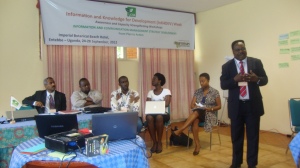
The CTA organised two side events during theRUFORUM Biennial Meeting –
  1. Scientific Writing for shortlisted participants of the Women in Science competition – managed by JAF, and 
  2. InK4Dev Week – consisting of 3 parallel sessions on (a) Training of Trainers on ICM Strategy development at ARD institutions; (b) Training of Trainers on Monitoring and Evaluation of Information Projects, Products and Services (c) Sensitisation on use of ICT tools for agricultural research techniques and information sharing.

Rabu, 18 April 2012

First Africa Forum on Science, Technology and Innovations

1-3 April 2012, Nairobi. The first Africa Forum on Science, Technology and Innovations highlighted the need to invest in this key sector to foster sustainable growth and development and provide job opportunities for youth and women.

The event was organized by the Government of Kenya, the African Development Bank (AfDB), the UN Educational, Scientific and Cultural Organization (UNESCO), the African Union Commission (AU), and the UN Economic Commission for Africa (UNECA), in collaboration with the Association for the Development of Education in Africa (ADEA). It featured a two-day Experts’ Meeting, followed by a day-long Ministerial Conference.

The ministerial conference concluded with the signing of the Nairobi Ministerial Declaration on Science, Technology and Innovation (STI). The declaration includes a range of measures to harness STI for sustainable development.  [Nairobi Ministerial Declaration on Science, Technology and Innovation] [African Union Announcement] [AfDB Announcement] [AfDB Press Release] [UNESCO Event Announcement] [UNESCO Press Release]


Success stories

Kenya’s young to digitalize farming

A group of young graduates in Kenya have introduced a mobile-phone enabled technology which will help farmers in rural Africa to link up with crop researchers, meteorological departments and veterinary scientists to better their farm yields.
Calvins Okello, a science graduate from the Jomo Kenyatta University of Agriculture and Technology (JKUAT) and a colleague, Gordon Owiti, have developed the new technology that seeks to digitalize Africa’s agriculture and enable the government agencies to solve the crisis of
poor food distribution. read more

Parallel session 4: Agriculture and Food Security

Chair: Mary Abukutsa, Jomo Kenyatta University of Agriculture and Technology, Kenya
Provocateur: Moses Osiru, Deputy Executive Secretary, RUFORUM
Rapporteur: Abdou Chakour CHADHOULIATI (Bioscience) Directrice Générale Adjointe de l'Institut National de Recherche pour l'Agriculture, la Pèche et l'Environnement (INRAPE), Ministère de l'Agriculture, Pèche, Environnement, Energie, Industrie et Artisanat, Comoros
Facilitator : Christina Golubski, Program Associate, The Global Knowledge Initiative
Interactive Participants:
  • Benedict Kanu, Lead Specialist, Agriculture & Agro Industry Dept, AfDB
  • El Tayeb Alhag Ali Ahmed, UNESCO Chair in Desertification, the University of Khartoum, Sudan
  • Damien Conaré, Secretary- General UNESCO Chair "alimentations du monde", Institut des régions chaudes, Montpellier SupAgro, France
  • Ray Elliot, Strategic Project Leader, Syngenta, London, United Kingdom
  • Prof Esther Murugi, Deputy Vice Chancellor, JKUAT, Kenya


Interview of Lidia Brito, Director of Science Policy and Capacity Building, UNESCO Science, technology and innovation (STI) are important issues for Africa, an increasingly dynamic continent. On the occasion of the First African Forum on Science, Technology and Innovation (STI) for Youth Employment, Human Capital Development and Inclusive Growth, from 1 to 3 April in Nairobi, Kenya, Lidia Brito talks about the importance of STI in the African context and how it will contribute to sustainable development in Africa in the run up to the Rio + 20 conference in June 2012.

Kamis, 29 Maret 2012

TEAM Africa Planning Meeting

26 - 28 March 2012. Wageningen. The World Bank and Wageningen University and Research Centre organized a workshop on ‘Support to Tertiary Agricultural Education in Africa’. The Workshop, which was held in Wageningen, the Netherlands, follows on earlier discussions on higher education in agriculture at the Kampala Ministerial Conference (November 2010), the first TAE-Partnership workshop launching it in Ås, Norway (September 2011), and at subsequent meetings in Ouagadougou (November 2011) and Washington DC (December 2011).

Given the level of renewed interest in African TAE, several development partners and knowledge institutions in Africa, Europe and Northern America have initiated this series of discussions to explore how they might scale up and coordinate their support for TAE initiatives in Africa. The Wageningen workshop was intended to further strengthen this TAE-Partnership and to be the next step in that effort.

Specifically, the workshop participants discussed:

  1. Lessons learned from past and current programs of support to TAE in Africa;
  2. Africa’s plans for TAE (as expressed by the leaders of the TEAM Africa initiative) and how best to support them;
  3. Possible forms through which development partners might increase the coordination and alignment of their support for TAE in Africa;
  4. Next Steps towards achieving better coordination of development partners, and further alignment with the African agenda for TAE.

The workshop brought some 60 African, North American and European stakeholders in agricultural education together, including Development Partners (World Bank, USAid, DGIS, AFD, CDA, FAO, CTA, DAAD, NUFFIC, Bill & Melinda Gates Foundation, GlobalHort), Regional Coordination Fora (FARA/CAADP, RUFORUM, ANAFE, Team Africa) and African as well as northern universities and knowledge Institutions (APLU, AGRINATURA, Université d’Abomey Calavi, Sokoine University of Agriculture, Stellenbosch University, Michigan State University, OHIO State University, Université de Liège, Norwegian Institute for Agricultural and Environmental Research, the University of Helsinki, Finlkand, the Swedish University of Agricultural Sciences, Wageningen UR, the Netherlands’ Royal Tropical Institute, the Faculty of Life Sciences of the University of Copenhagen, Denmark, SupAgro and Agreenium from France, NRI/University of Greenwich, UK and ICRA.

The workshop participants discussed new mechanisms to support TAE in Africa by assessing lessons learned from past and current support programs, and by matching possible new initiatives with Africa’s own plans for TAE, as expressed in Pillar 4 of the Comprehensive Africa Agricultural Development Programme of NEPAD, and by the World Bank supported TEAM Africa initiative. The latter comprises of a new coordination unit, hosted by the Regional Universities Forum for Capacity Development in Agriculture (RUFORUM) and the African Network for Agriculture, Agroforestry and Natural Resources Education (ANAFE). Specifically the Wageningen Workshop aimed to align the various North American and European donor support mechanisms as well as (bilateral) university partnership programmes and how best to support them.

Jumat, 23 Desember 2011

Boosting Agricultural Higher education into CAADP

28th to 30th November 2011. Ouagadougou, Burkina Faso. The African Network for Agriculture, Agroforestry and Natural Resource Education (ANAFE), ACP-EU Technical Centre for Agricultural and Rural Development Cooperation (CTA), Forum for Agricultural Research in Africa (FARA), the NEPAD Coordinating Agency, CORAF-WECARD and the Regional Universities Forum for Capacity Building in Agriculture (RUFORUM) held a Sensitization workshop for Engaging French Speaking African Higher Agricultural Education Institutions into CAADP.

Other key partners of the organization are the University of Ouagadougou, University of Abomey Calavi (Benin), the Association of African Universities (AAU), the African and Malagasy Council for Higher Education (CAMES), the Conference of rectors of Universities of Francophone West Africa, Central and Indian Ocean (CRUFAOCI), the Network of Institutions of higher Education in
Fishing (Afri-FishNet), the European Alliance on Agricultural Knowledge for development (Agrinatura) and the French consortium Agreenium.

During the three days conference, a number of papers were presented, followed by debates and discussions, and propositions made. This led to the following results:
  • An increased awareness about the objectives, the constants and the expected outputs of the CAADP;
  • A better understanding of the role to be played by Universities and other agricultural higher education institutions in cooperation with their supervisory ministries and those in charge of agriculture;
  • The massive presence at the meeting of Universities, other higher education institutions and technical and financial partners, is a testimony of their willingness to be involved in actions undertaken for the attainment of the CAADP objectives;
  • Important activities were formulated which will lead to a stronger involvement of agricultural training institutions;
  • Concertation frameworks were proposed with CAADP, ANAFE, RUFORUM and FARA which will be able to serve for interaction between Universities and Agricultural training institutions.
Resources: