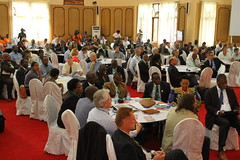
5-6 February 2012. Dakar. The Fifth General Meeting of the Coalition for African Rice Development (CARD) was held to review progress in a 10 year initiative to double Sub-Sahara Africa’s rice production.
The conference reviewed the progress and challenges of the rice sector development in Sub-Sahara Africa during the past five years and discussed the key activities of the next five years.
Background:
The CARD initiative was launched during the 2008 Fourth Tokyo International Conference on African Development (TICAD IV) jointly by the Japan International Cooperation Agency (JICA) and the Alliance for a Green Revolution in Africa (AGRA) to help strengthen overall African agricultural development.
Other CARD members are the Japan International Research Center for Agricultural Sciences (JIRCAS), the Forum for Agriculture Research in Africa (FARA), the Africa Rice center, the New Partnership for Africa's Development (NEPAD), the International Fund for Agricultural Development (IFAD), the World Bank, the African Development Bank (AfDB), the International Rice Research Institute (IRRI) and the UN’s Food and Agricultural Organization (FAO).
The initiative aims to double Sub-Sahara Africa’s rice production to 28 million tons by 2018, through coordination of all the stakeholders including governments, donors, NGOs and private enterprises.
Tampilkan postingan dengan label AGRA. Tampilkan semua postingan
Jumat, 15 Februari 2013
Rabu, 12 Desember 2012
Chatham House Food Security 2012 Sustainable Intensification
10-11 December 2012. London, UK. This conference examined the potential of technologies – old, new and pipeline – to deliver sustainable intensification in agriculture.
Is a resilient global agricultural system achievable?
Kanayo F. Nwanze, President of International Fund for Agricultural Development (IFAD) and Alliance for a Green Revolution in Africa (AGRA) President Jane Karuku called for a continued global push for increased smart investments in Africa's agriculture, both by governments and the private sector. After speaking at the Chatham House Food Security 2012 Sustainable Intensification: Miracle or Mirage conference, Nwanze and Karuku addressed a group of international media in London emphasizing that farming is a business and the private sector must fuel the development of Africa's agribusiness in upgrading smallholder agriculture to meet demand from foreign and emerging markets in developing countries.
Food Security: Priorities for Action - Catherine Woteki of USDA
Is a resilient global agricultural system achievable?
- Is technology crucial to delivering increased agriculture outputs in tandem with environmental objectives?
- Is the current regulation evidence-based or driven by the public’s perception of risk?
Food Security: Priorities for Action - Catherine Woteki of USDA
Kamis, 18 Oktober 2012
2012 Borlaug Dialogue: Partnerships & Priorities: Transforming the Global Food Security Agenda
October 17-19, 2012 – Des Moines, Iowa. The 2012 "Borlaug Dialogue" international symposium in Des Moines, Iowa, focused on the theme “The Next Generation: Confronting the Hunger Challenges of Tomorrow.” It brought more than 1,000 visitors from more than 70 countries to Des Moines to address cutting-edge issues in food security and nutrition.
Wednesday October 17
Collaborating for Growth: How public-private partnerships are improving nutrition, productivity and sustainability
CropLife International and a panel of experts discussed how unique, new partnerships will create economic and environmental benefits for farm communities. Panelists will share stories on three high-profile partnerships that are breaking new ground to provide greater global nutrition, crop yields and farmer advocacy.
Speakers Included:
-Denis Kyetere - Executive Director, African Agricultural Technology Foundation. Sharing the success of the Water Efficient Maize for Africa Project
-Marc Albertsen - Senior Researcher Fellow, DuPont-Pioneer. Presenting Progress of the African Biofortified Sorghum Project
- Robert Carlson - President, World Farmers Organization. Discussing achievements of the Farming First Coalition
Setting the Stage - One Billion Hungry: Can We Feed the World Sustainably?
Speakers Included:
Sir Gordon Conway - Professor of International Development, Imperial College London
Gebisa Ejeta - Distinguished Professor of Plant Breeding & Genetics & International Agriculture, Purdue University
Susan Godwin - Smallholder Farmer, Nigeria
Jane Karuku - President, Alliance for a Green Revolution in Africa (AGRA)
Roger Thurow (Moderator) - Senior Fellow, The Chicago Council on Global Affairs
This session discussed on a high level the future landscape of feeding a growing population in a world affected by environmental, geopolitical, technological and other pressing challenges.
Specifically, this conversation explored the following:
- How can we put current issues in perspective with regard to the future? Where should we prioritize?
- What do we have to look forward to in terms of developments to combat global hunger?
- What are some important questions regarding this issue that have yet to be asked?
- What does it really mean to cultivate effective partnerships? Why are some effective and some not?
- How do we advance agricultural development while minimizing environment impact?
- How do we bring all interests and stakeholders to the table in an equitable manner?
Thursday, October 18
Working Capital: Leveraging Global Financial Tools for Smallholder Farmers
Speakers Included
Walter Bell - Board of Directors, Swiss Re America Holding
Raymond Offenheiser - President, Oxfam America
Sano Shimoda - Founder and President, BioScience Securities
Jack Sinclair - Executive Vice-President, Walmart Grocery Division
Carolyn Woo - CEO, Catholic Relief Services
Feed the Future: Innovating for Impact
This side event, hosted by USAID and its U.S. Government partners in the Feed the Future initiative, will be moderated by author and journalist Roger Thurow and will highlight how investments in agricultural research and capacity development under Feed the Future are impacting lives worldwide. The session will include a panel discussion with major partners from the private sector, U.S. universities, and international research centers; AgTalks from key researchers; and dynamic content showing the impacts of the portfolio and future leaders in agricultural research.
Friday, October 19
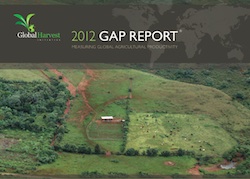
The Global Harvest Initiative’s (GHI) annual Global Agricultural Productivity Report® (GAP Report®), was released on October 17, before an audience of global thought leaders, agricultural industry experts, farmers, and international development professionals. This is the third annual GAP Report® released by GHI since the organization’s inception in 2009.
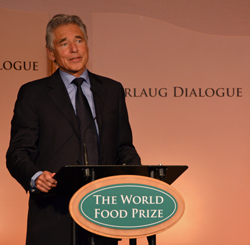
Download the 2012 GAP Report® (PDF) Related:October 16, 2012. A pioneer who made arid lands bloom is the recipient of this year's prestigious World Food Prize. Daniel Hillel developed drip irrigation techniques that squeeze the most crop out of a drop of water, making farming possible in places where water is scarce. Hillel’s orchards near his home in Israel are innovation in action. Each tree row is fed by plastic tubes which drip water at the base of the tree. Irrigating drop by drop - called drip irrigation - has transformed agriculture by dramatically reducing the amount of water needed.
Related: The African Market Garden
A smarter approach to agriculture, is for farmers to produce more vegetables for home consumption and sale in urban areas. As a result, Pasternak has developed the Africa Market Garden concept. In Tanka village, 50 women have started farming using solar drip irrigation to grow okra, tomatoes, eggplant, and other vegetables, as well as moringa and fruit trees. The women each manage their own plots, but share tools and water—and skills—with one another. They all contribute their earnings to a group savings account to pay for things like fertilizer or to replace hoses and other materials. By selling their vegetables at nearby markets most of the women have tripled their incomes from about $USD 350.00 per woman per year to more than $1,000.00. And that extra income means that their families eat better, that they can send their children to school, and buy clothes and other things they need.
Chairman of the Board of Directors, Nestlé |
A number of the Borlaug Dialogue sessions will be webcast live, available free to the public to watch.
This three-day dialogue explored topics such as:
- What will a future landscape of a hungry world look like and how will we feed it sustainably?
- Water and Environment – How can agriculture become a part of the conservation solution and not the problem?
- Feeding Capacity – Studying past successes and future opportunities for academia to influence the global conversation
- Nutrition Value – Integrating nutrition across the entire value chain from production to consumer
- Working Capital – Leveraging global financial tools to empower smallholder farmers and entrepreneurs
- Measuring Success – From stockholder to smallholder, what are the common indicators for a successful partnership?
- Game Change – Emerging technologies shaping the future of food & agricultural development
- Waste Not, Want Not – Increased productivity is only one part of the food security equation. What are the advancements in minimizing waste in the supply chain, especially in post-harvest loss?
- Spread the Word – The role of the media in informing the public and bringing food security issues to the forefront
Collaborating for Growth: How public-private partnerships are improving nutrition, productivity and sustainability
CropLife International and a panel of experts discussed how unique, new partnerships will create economic and environmental benefits for farm communities. Panelists will share stories on three high-profile partnerships that are breaking new ground to provide greater global nutrition, crop yields and farmer advocacy.
Speakers Included:
-Denis Kyetere - Executive Director, African Agricultural Technology Foundation. Sharing the success of the Water Efficient Maize for Africa Project
-Marc Albertsen - Senior Researcher Fellow, DuPont-Pioneer. Presenting Progress of the African Biofortified Sorghum Project
- Robert Carlson - President, World Farmers Organization. Discussing achievements of the Farming First Coalition
Speakers Included:
Sir Gordon Conway - Professor of International Development, Imperial College London
Gebisa Ejeta - Distinguished Professor of Plant Breeding & Genetics & International Agriculture, Purdue University
Susan Godwin - Smallholder Farmer, Nigeria
Jane Karuku - President, Alliance for a Green Revolution in Africa (AGRA)
Roger Thurow (Moderator) - Senior Fellow, The Chicago Council on Global Affairs
This session discussed on a high level the future landscape of feeding a growing population in a world affected by environmental, geopolitical, technological and other pressing challenges.
Specifically, this conversation explored the following:
- How can we put current issues in perspective with regard to the future? Where should we prioritize?
- What do we have to look forward to in terms of developments to combat global hunger?
- What are some important questions regarding this issue that have yet to be asked?
- What does it really mean to cultivate effective partnerships? Why are some effective and some not?
- How do we advance agricultural development while minimizing environment impact?
- How do we bring all interests and stakeholders to the table in an equitable manner?
Reducing Postharvest Loss to Advance Food Security
This seminar, hosted by the ADM Institute for the Prevention of Postharvest Loss, addressed knowledge gaps which contribute to the loss of agricultural produce in food supply chains and the means to reduce those gaps.
Working Capital: Leveraging Global Financial Tools for Smallholder Farmers
Speakers Included
Walter Bell - Board of Directors, Swiss Re America Holding
Raymond Offenheiser - President, Oxfam America
Sano Shimoda - Founder and President, BioScience Securities
Jack Sinclair - Executive Vice-President, Walmart Grocery Division
Carolyn Woo - CEO, Catholic Relief Services
This side event, hosted by USAID and its U.S. Government partners in the Feed the Future initiative, will be moderated by author and journalist Roger Thurow and will highlight how investments in agricultural research and capacity development under Feed the Future are impacting lives worldwide. The session will include a panel discussion with major partners from the private sector, U.S. universities, and international research centers; AgTalks from key researchers; and dynamic content showing the impacts of the portfolio and future leaders in agricultural research.
Waste Not, Want Not: Solutions for Reducing Post Harvest Loss
Betty Bugusu - Managing Director, International Food Technology Center
Jeffrey Klein - President and CEO, The Global FoodBanking Network
Rajesh Kumar - Smallholder Farmer
Steve Sonka - Director, ADM Institute for the Prevention of Postharvest Loss
Betty Bugusu - Managing Director, International Food Technology Center
Jeffrey Klein - President and CEO, The Global FoodBanking Network
Rajesh Kumar - Smallholder Farmer
Steve Sonka - Director, ADM Institute for the Prevention of Postharvest Loss
Value Added: Integrating Nutrition for Human and Animal Health
Marc Van Ameringen - Executive Director, Global Alliance for Improved Nutrition (GAIN) (moderator)
Florence Chenoweth - Minister of Agriculture, Liberia
Jim Gerardot - Executive Director of Solutions, Novus International
Mehmood Khan - CEO of the Global Nutrition Group, PepsiCo
Katherine Pickus - Divisional Vice President, Global Citizenship and Policy, Abbott
Marc Van Ameringen - Executive Director, Global Alliance for Improved Nutrition (GAIN) (moderator)
Florence Chenoweth - Minister of Agriculture, Liberia
Jim Gerardot - Executive Director of Solutions, Novus International
Mehmood Khan - CEO of the Global Nutrition Group, PepsiCo
Katherine Pickus - Divisional Vice President, Global Citizenship and Policy, Abbott
Related:
Download the 2012 GAP Report® (PDF) Related:October 16, 2012. A pioneer who made arid lands bloom is the recipient of this year's prestigious World Food Prize. Daniel Hillel developed drip irrigation techniques that squeeze the most crop out of a drop of water, making farming possible in places where water is scarce. Hillel’s orchards near his home in Israel are innovation in action. Each tree row is fed by plastic tubes which drip water at the base of the tree. Irrigating drop by drop - called drip irrigation - has transformed agriculture by dramatically reducing the amount of water needed.
Related: The African Market Garden
A smarter approach to agriculture, is for farmers to produce more vegetables for home consumption and sale in urban areas. As a result, Pasternak has developed the Africa Market Garden concept. In Tanka village, 50 women have started farming using solar drip irrigation to grow okra, tomatoes, eggplant, and other vegetables, as well as moringa and fruit trees. The women each manage their own plots, but share tools and water—and skills—with one another. They all contribute their earnings to a group savings account to pay for things like fertilizer or to replace hoses and other materials. By selling their vegetables at nearby markets most of the women have tripled their incomes from about $USD 350.00 per woman per year to more than $1,000.00. And that extra income means that their families eat better, that they can send their children to school, and buy clothes and other things they need.

Senin, 01 Oktober 2012
African Green Revolution Forum 2012
26 - 28 September 2012. Arusha, Tanzania. The African Green Revolution Forum (AGRF) in Arusha has concluded with the production of concrete actions to transform Africa’s agricultural sector. African heads of state, ministers, private sector representatives, the international community and farmers united on the roadmap for increasing agricultural productivity and income growth for the African agricultural sector, with support for smallholder farmers at the centre of all solutions.
The AGRF 2012 action areas focused on four major themes:
At his closing remarks at AGRF 2010 in Accra, Kofi Annan declared that the continent had arrived at the “tipping point” in the challenge of scaling up Africa’s Green Revolution. Two years on, the AGRA Chair is convinced that agriculture in Africa has begun to accelerate beyond the tipping point, stating that there has been a rising level of interest and action to improve the agricultural policy environment.
“Public- and private-sector leaders are joining forces in unprecedented ways to ensure a more food secure future,” he said. “We have seen great success when players come together and invest strategically – we hope to build on new momentum and work together to transform agriculture in Africa.” Commenting on the success of the forum and the critical next steps, AGRA President, Jane Karuku stated that “the international community is beginning to realize that the smallholder is an entrepreneur, and that farming is a business.
AGRF inspired tremendous discussions and developed actionable plans to bring us closer to achieving food and nutrition security. It is critical that we move forward with these real, practical and pragmatic actions at the farmer-level, not at the office-level.” President Jakaya Kikwete has strongly defended the need to scale up investments and innovation for sustainable agricultural growth and food security in Africa by putting at the centre of agriculture smallholder farmers whose production and productivity is low.
The government of Tanzania is planning a mechanism which will ensure all agricultural meetings and workshops are held in places where farmers will be given opportunity to participate directly in initiatives and discussions involving the relevant issues for implementation.
The AGRF 2012 action areas focused on four major themes:
- rethinking public-private partnerships,
- revolutionizing agricultural finance,
- making markets work, and
- building the foundations for rapid growth in agricultural productivity.
At his closing remarks at AGRF 2010 in Accra, Kofi Annan declared that the continent had arrived at the “tipping point” in the challenge of scaling up Africa’s Green Revolution. Two years on, the AGRA Chair is convinced that agriculture in Africa has begun to accelerate beyond the tipping point, stating that there has been a rising level of interest and action to improve the agricultural policy environment.
“Public and private investment in agriculture increased, due to better policies and regulatory measures”, he said. “We have seen greater small-holder access to improved, higher yielding seed of stable foods, and to more affordable fertilizer and better techniques for its application, such as microdosing. Significant investments have taken place in large breadbasket areas in Ghana, Mali, Mozambique and here in Tanzania, as well as in several agricultural growth corridors”.Following recent discussions at the World Economic Forum (WEF) Africa, the G8 and David Cameron’s Hunger Summit, the African Green Revolution Forum is seeking ways to unite the power of the public- and private-sectors in the global food security efforts. Yara President and Chief Executive Officer, Jørgen Ole Haslestad, who is the co-chair of the Forum, said the AGRF serves as an important incubator for innovative solutions to growing the African agricultural sector.
The Minister for Agriculture, Food and Cooperatives, Eng Christopher Chiza, and the President of the Alliance for a Green Revolution in Africa (AGRA), Ms Jane Karuku |
AGRF inspired tremendous discussions and developed actionable plans to bring us closer to achieving food and nutrition security. It is critical that we move forward with these real, practical and pragmatic actions at the farmer-level, not at the office-level.” President Jakaya Kikwete has strongly defended the need to scale up investments and innovation for sustainable agricultural growth and food security in Africa by putting at the centre of agriculture smallholder farmers whose production and productivity is low.
The government of Tanzania is planning a mechanism which will ensure all agricultural meetings and workshops are held in places where farmers will be given opportunity to participate directly in initiatives and discussions involving the relevant issues for implementation.
Jumat, 27 April 2012
Businesses in Agric Sector Get Funding Boost
April 15, 2012. The Africa Enterprise Challenge Fund (AECF) has launched a new competition for agri-business and rural financial services for Liberia and Sierra Leone, DR. Congo, and Somalia. The competition allows privately-owned businesses involved in the agriculture sector in the post-conflict economies of Liberia, Sierra Leone, DR Congo, and Somalia to compete for its matching grant funds, which range from US$250,000 to US$1.5 million per project.
The AECF runs competitions open only to for-profit companies, and has to date funded over 80 projects in Africa including three in Sierra Leone. KPMG is the Fund Manager of the AECF. The competition seeks innovative business ideas in agri-business, financial services and value chains that combine commercial viability with development.
The West Africa Director of the Fund, Dr. George Manu, told reporters during the launch in Monrovia on Wednesday, April 19, 2012 that:
The AECF runs competitions open only to for-profit companies, and has to date funded over 80 projects in Africa including three in Sierra Leone. KPMG is the Fund Manager of the AECF. The competition seeks innovative business ideas in agri-business, financial services and value chains that combine commercial viability with development.
The West Africa Director of the Fund, Dr. George Manu, told reporters during the launch in Monrovia on Wednesday, April 19, 2012 that:
A project must be commercially viable and have a positive impact on the rural poor in Africa in order to qualify for funding. Furthermore, as the AECF operates on a risk sharing basis, companies applying would need to match our funding or make significant contribution to the projects.
Senin, 21 November 2011
Innovations in Extension and Advisory Services
15-18 November 2011, Nairobi, Kenya. Over 400 academics, researchers, extension agents, farmers´ representatives, media experts, policy makers and representatives from international organizations and donors met in Nairobi to discuss innovations in extension and advisory services for food and livelihoods.
The Technical Centre for Agricultural and Rural Cooperation ACP-EU (CTA), the Forum for Agricultural Research in Africa (FARA), the Global Forum for Rural Advisory Services (GFRAS), the International Fund for Agricultural Development (IFAD), the Food and Agricultural Organization (FAO), the Alliance for a Green Revolution in Africa (AGRA), the African Forum for Agricultural Advisory Services (AFAAS), the New Partnership for Africa’s Development Planning and Coordinating Agency (NEPAD Agency), the International Centre for development oriented Research in Agriculture (ICRA) and the World Agroforestry Centre (ICRAF) in collaboration with several national, regional and international partners including the African Network for Agriculture, Agroforestry and Natural Resources Education (ANAFE), Biovision, the Kenya Agricultural Research Institute (KARI), the Ministry of Agriculture – Kenya, the European Initiative on Agricultural Research for Development (EIARD), the University of Nairobi, the University of the West Indies (UWI) and the University of the South Pacific (USP) organised this an international conference to take stock of current policies, thinking and practice, successes and failures of ongoing and past reforms in extension and advisory services and build a coalition moving forward to specifically address meeting the future needs of small-holder farmers, marginalized communities, women and youth in a sustainable and cost effective manner. This conference integrated the GFRAS 2nd annual conference.
Farmer-managed innovation funds drive multi-stakeholder learning processes.
Ann Waters-Bayer is an agricultural sociologist with ETC AgriCulture in Leusden, Netherlands. She specialises in social and institutional aspects of research and development, especially innovation processes that enhance local capacities to adapt to change.
She is also team member in two European Community-funded projects: JOLISAA (Joint Learning in Innovation Systems in African Agriculture), which operates in Benin, Kenya and South Africa; and INSARD (Including Smallholders in Agricultural Research for Development), which involves NGOs and farmer organisations in Africa and Europe. She has (co-)authored several books and articles on pastoralist development and on innovation processes involving smallholders in Africa.
by Giel Ton, LEI Wageningen UR, Agrinatura
Maurice Bolo, African Technology Policy Studies Network (ATPS)
The Technical Centre for Agricultural and Rural Cooperation ACP-EU (CTA), the Forum for Agricultural Research in Africa (FARA), the Global Forum for Rural Advisory Services (GFRAS), the International Fund for Agricultural Development (IFAD), the Food and Agricultural Organization (FAO), the Alliance for a Green Revolution in Africa (AGRA), the African Forum for Agricultural Advisory Services (AFAAS), the New Partnership for Africa’s Development Planning and Coordinating Agency (NEPAD Agency), the International Centre for development oriented Research in Agriculture (ICRA) and the World Agroforestry Centre (ICRAF) in collaboration with several national, regional and international partners including the African Network for Agriculture, Agroforestry and Natural Resources Education (ANAFE), Biovision, the Kenya Agricultural Research Institute (KARI), the Ministry of Agriculture – Kenya, the European Initiative on Agricultural Research for Development (EIARD), the University of Nairobi, the University of the West Indies (UWI) and the University of the South Pacific (USP) organised this an international conference to take stock of current policies, thinking and practice, successes and failures of ongoing and past reforms in extension and advisory services and build a coalition moving forward to specifically address meeting the future needs of small-holder farmers, marginalized communities, women and youth in a sustainable and cost effective manner. This conference integrated the GFRAS 2nd annual conference.
“With the global population approaching nine billion by 2050, we need widespread adoption of farming practices that can sustainably increase yields in a changing climate to feed more people, while also creating new job and market opportunities to address high unemployment and poverty,” Michael Hailu, executive director of the Netherlands-based Technical Centre for Agricultural and Rural Cooperation, was quoted as saying in a statement by the organisation, which organised the conference.
“Smallholder farmers - particularly women - produce the bulk of food in developing countries, often under difficult circumstances,” he added. “National governments and international donors must redouble their efforts to boost smallholder agricultural production if we are to reverse persistent food insecurity and rural poverty.”
- Day 1 - Presentations
- Day 2 - Field trip overview (pdf)
- Day 3 - Presentations
- Day 4 - Presentations
- Full program (pdf)
Farmer-managed innovation funds drive multi-stakeholder learning processes.
She is also team member in two European Community-funded projects: JOLISAA (Joint Learning in Innovation Systems in African Agriculture), which operates in Benin, Kenya and South Africa; and INSARD (Including Smallholders in Agricultural Research for Development), which involves NGOs and farmer organisations in Africa and Europe. She has (co-)authored several books and articles on pastoralist development and on innovation processes involving smallholders in Africa.
Empowering smallholder farmers in markets: experiences in collaborative research with national farmer organisations to improve pro-active advocacy for smallholder market access.
Extension, advisory services and capability building along the value chain: Do partnerships between farmers and exporters lead to learning and innovation?
Kamis, 03 November 2011
Increasing Agricultural Productivity and Enhancing Food Security in Africa: New Challenges and Opportunities
The November 1–3 conference “Increasing Agricultural Productivity and Enhancing Food Security in Africa: New Challenges and Opportunities,” was co-organized by the International Food Policy Research Institute (IFPRI), the African Union Commission (AUC), the United Nations Economic Commission for Africa (UNECA), and the Forum for Agricultural Research in Africa (FARA). Speakers and participants showcased opportunities to improve agricultural productivity and explored how they can be effectively implemented through the framework of the Comprehensive Africa Agriculture Development Programme.
Experts at the conference also examined issues related to:
- science, technology, and innovation in agriculture;
- rural services and access to inputs;
- markets, trade, and regional integration and value chains;
- investments, institutions, and policies for supporting agriculture;
- agriculture, nutrition, and health linkages;
- agriculture and climate change mitigation and adaptation;
- capacity development for agriculture through education and training; and
- the nexus of agriculture and the rural nonfarm sector in growth and poverty reduction
Stephen Muchiri of the Eastern Africa Farmers Federation said:
“The major challenge in increasing agriculture productivity in Africa is low agro investment, markets are not well developed, there are market restrictions, farmers can’t easily access the market, and they don’t have power to have their own markets. If there is no access to markets, the entire value chain will be affected. Markets are the way to boost research, input, credit facilities and risk mitigation. When farmers are involved in value chains they are going to be able to access market information that helps them prepare their production in ways that suit market demand.”Keynote Speech by Yusuf Abubakar, ARCN. Strengthening capacity for agricultural science and technology in Africa
Keynote Speech by Namanga Ngongi, AGRA. Delivering African agricultural productivity and food security through a Green Revolution: prospects and challenges
Sabtu, 03 September 2011
African parliamentary support for agriculture
African parliamentary support for agriculture. Final Report for the Pilot Programme. Association of European Parliamentarians with Africa. 29 pp.
This is the final report of a pilot programme which investigated how parliamentary agriculture committees can be supported to help to provide better oversight on programmes looking at such things as achieving sustainable agricultural growth, food security and economic empowerment of smallholder farmers. It covered Ghana, Kenya, Rwanda and Tanzania.
The programme looked at ways in which agricultural committees can be assisted to develop and implement a strategic approach to support agriculture in their respective countries and constituencies.
The report acknowledges that much more work needs to be done to develop the link between MPs and government agricultural services such as the extension services at constituency level.
It also suggested that any future programme would need to put more emphasis on strengthening (or in some cases establishing) the links within a parliaments; between parliamentary committees and the executive; between different houses of parliament (two of the four countries have or will have senates as well as assemblies); and between parliamentary committees and other stakeholders such as farmers' organizations and research institutions.
This is the final report of a pilot programme which investigated how parliamentary agriculture committees can be supported to help to provide better oversight on programmes looking at such things as achieving sustainable agricultural growth, food security and economic empowerment of smallholder farmers. It covered Ghana, Kenya, Rwanda and Tanzania.
The programme looked at ways in which agricultural committees can be assisted to develop and implement a strategic approach to support agriculture in their respective countries and constituencies.
The report acknowledges that much more work needs to be done to develop the link between MPs and government agricultural services such as the extension services at constituency level.
It also suggested that any future programme would need to put more emphasis on strengthening (or in some cases establishing) the links within a parliaments; between parliamentary committees and the executive; between different houses of parliament (two of the four countries have or will have senates as well as assemblies); and between parliamentary committees and other stakeholders such as farmers' organizations and research institutions.
Langganan:
Postingan (Atom)