Senin, 07 Mei 2012

8th CAADP Partnership Platform

3rd and 4th of May 2012. Nairobi Kenya. The African Union Commission (AUC) and NEPAD Planning and Coordinating Agency (NPCA) organised the 8th CAADP Partnership Platform (PP) Meeting around the theme of the meeting “Accelerating CAADP Implementation for results and impact.”

Over 200 participants, including agriculture experts, researchers, policy makers, civil society, development partners, farmers' groups and media from within Africa and beyond attended the two-day event.

The President of Pan African Farmers Organization (PAFO), Ms. Elizabeth Atangana, urged CAADP to put in place the mechanism for marketing Africa agriculture produce. She said the programme should also encourage agricultural research, promote inter-countries trade, strengthen cooperative societies, and empower women and youths in African rural areas. 

“CAADP is an opportunity but the slow implementation of its agenda is of concern to farmers. In Central Africa, the launch of CAADP is still facing a lot of challenges. I hope that this meeting will give us space and lead to conclusion, implementation and joining of countries that have not joined,” she said.

Background: CAADP was established in 2003 as part of the AU's NEPAD programme and as Africa's response to the various challenges facing agriculture in the continent. Some of its main goals are to influence countries to increase their budgetary allocation to agriculture by 10%, achieve 6% growth, promote land and water management, agricultural research, marketing and food security. Some 30 countries have signed the CAADP compact, which is a blueprint for accelerating agricultural growth, while over 24 countries have established agriculture and food security investment plans.

PAEPARD 2nd European Multi-Stakeholder Consultation

3 and 4 May 2012. Brussels. BTC-CTB center. PAEPARD 2nd European Multi-Stakeholder Consultation

The main objective of this PAEPARD workshop was an exchange between non-research and research stakeholders or "research users" (producer organizations, private sector, NGOs) to explore possibilities of establishing a multi-stakeholder inclusive and balanced in the field of Agricultural Research for Development (ARD), in order to foster a more demand-driven approach in ARD.

In order to reach the objectives and expected results, the workshop was organized around: “how to make researchers and users work together?” by focusing on models of partnerships and funding and support mechanisms.

The workshop was fed by the lessons learned from PAEPARD experience accumulated over the past two years, which were presented and analyzed.

Models of partnerships 
It is possible to distinguish between several types of partnership models by considering the role played by different actors, in particular in terms of their initiative, definition of problems or challenges, implementation, evaluation and a host of other factors. Based on the idea that 'there is no perfect model' the workshop analyzed various existing models in order to ascertain and highlight their relative advantages and risks.


Funding mechanisms and support mechanisms for partnerships 
In light of identified models of partnerships and items to promote benefits or to avoid risks, the workshop aimed to analyze existing funding mechanisms and set recommendations. Further, the workshop addressed some mechanisms to support balance and inclusive partnerships, particularly those set up by PAEPARD.

PAEPARD experiences 
Those questions were introduced by analyzes based on the experience of PAEPARD from several sources:
  1. Case studies conducted by PAEPARD partners 
  2. Representatives of consortia supported by PAEPARD. 
Following persons represented consortia at the PAEPARD 2nd European Multi-Stakeholder Consultation :
  • Adler CORNEL, Federal Research Center for Cultivated Plants, Julius Kuhn Institute, Germany for the consortium of Ghana/Malawi - Improving food security and income for smallholder farmers through improved post harvest technology
  • Joutsjoki VESA, MTT Agrifood Research Finland; for the consortium of Aflatoxin contamination management along the maize value chain in Kenya.
  • Cheikh Oumar Ba, INITIATIVE PROSPECTIVE AGRICOLE ET RURALE (IPAR), Senegal, for the consortium of Un partenariat Europe Afrique pour la création d’un outil de suivi de l’agriculture familiale
  • Vincent ANTONIO, Instituto valenciano de investigaciones agrarias (IVIA), Spain;
  • Control of Angular leaf spot disease of Citrus in Ghana

PAEPARD CSO consultation meeting

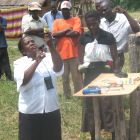
Thomas Price (GFAR Senior officer) addresses the participants
2 May 2012. Brussels.Espace Jacqmotte de la CTB (Coopération Technique Belge). PAEPARD-CSO consultation meeting: NGO and FO participation in Agricultural Research for Development. Mechanisms and instances at national, regional and global level and opportunities for NGO/FO coordination.

This workshop gathered European and African NGO and FO. It aimed at reviewing mechanisms and instances for NGOs and FOs participation to ARD, at different levels: global (GFAR/GCARD, CGIAR), continental/regional (EFARD, FARA, CORAF, ASARECA) and national. It focused on constraints to overcome and necessary conditions to ensure participation at these different levels and articulation between those levels. The day was organized around interventions of European and African experts and working groups to foster involvement of all participants.
  • General overview and historical background by Thomas Price 
  • Presentation about GFAR/ GCARD by Thomas Price 
  • Presentation about CGIAR by Christian Castellanet 
  • Presentation about EFARD by Ann Waters-Bayer 
  • Example of national level: Swiss National ARD Forum by Martina Graf 
  • Presentation about ASARECA by Mary-Jo Kakinda 
  • Presentation about CORAF and challenges at national level by Mamadou Goita

INSARD Advisory Group meeting

1 May 2012. Brussels, CSA office. INSARD Advisory Group meeting, back-to-back with PAEPARD meetings: the CSO consultation meeting of 2 May and the PAEPARD multi-stakeholder meeting of 3-4 May 2012.

One of the main deliverables for INSARD (INcluding Smallholders in Agricultural Research for Development) is to come up with a CSO coordination and consultation mechanism that allows CSOs (both NGOs and Farmer Organisations) to participate effectively in regional and international discussions on ARD.

Following the mapping study by Mutizwa Mukute and the international consultation meeting in Nairobi (19 Nov 2011), a summary outlining the overall strategic direction has been developed and shared widely (i.e. through the PAEPARD website and EFARD, and also the INSARD webpage (www.repaoc.org/insard). The INSARD consortium is working on a more elaborated strategy, which was shared and discussed with the Advisory Group. WP 1: CSO coordination and communication mechanism WP 2: Producing joint research outlines (in framework of pilot national ARD platforms) WP 3: Policy-influencing strategy

Successful innovation depends on engaging the grassroots

Technologies work better 
when adapted by users: 
a podcast in local languages 
helps farmers keep cows 
healthy. Lawrence Gudza
02/05/2012. SciDev. Technological innovation can't be imposed on poor people — they must be engaged to select ideas that suit their lives, wrote Lawrence Gudza. Lawrence Gudza is programme team leader for Responding to New Technologies at Practical Action Southern Africa, based in Zimbabwe. This article is part of a Spotlight on Supporting grassroots innovation.

We need inclusive, community-based approaches that consider how people use technologies in their daily lives. The key for institutions is to engage in a dialogue about technologies with communities — vulnerable groups, traditional leadership,policymakers, scientists and business people. 


Introducing technology through community approaches is a social process that empowers communities to take charge of their own development through debate. This promotes a technology agenda based on local priorities and strengthens alliances for collective action. The process is transparent, and focuses on the priorities and needs of communities. It accepts and incorporates the output from the engagement, and in so doing, a narrow focus on a particular technology is avoided. Instead, issues around the problem that technology could help solve are examined in broad terms.


For example, in 2006 a three-day workshop run by the UK-based organisation Practical Action, examined whether nanotechnologies can help achieve the Millennium Development Goal of halving the number of people without access to clean water by 2015. Not once did the organisers mention nanotechnology until the last day of the workshop. This allowed the dialogue to focus on the problem of water in broad terms — for example, access, availability and quality — and not on a specific technology. As a result, several preferred technologies were discussed — and when nanotechnology was proposed there were more questions about it than the organisers imagined before the workshop.
In 2008, a pilot study among a rural population of 51,000 in Zimbabwe, 'Sharing local content in local voices', another Practical Action project, tested mobile devices for podcasting information relevant to farmers — such as crop and livestock production, and food processing and preservation. Recording was done using local voices and languages. The project's impact exceeded expectations: apart from improving livelihoods through increased production and yields, it also helped establish markets for buyers and suppliers.

Programme DONATA : diffusion des nouvelles technologies agricoles en Afrique

La technique de multiplication rapide des boutures de manioc par recépage à Dabou en Côte d’Ivoire fait école en Afrique. Conçu par le FARA, le Forum pour la Recherche Agricole en Afrique, le CORAF-WICARD et financé par la BAD, la Banque Africaine de Développement, le programme DONATA est un projet dont le but est d’améliorer la productivité agricole en Afrique.

Dans le cadre d’un atelier chercheurs-médias organisé par le FARA/CTA, du 19 au 23 mars à Abidjan (Côte d’Ivoire), une trentaine de chercheurs et journaliste francophones de l’Afrique de l’Ouest et du Centre étaient sur les traces de ce projet exécuté à Dabou. Sur le site du village de petit Badien, la recherche agricole ivoirienne, les services de vulgarisation expérimentent la production de deux nouvelles variétés de manioc à haut rendement : Boucou I et Boucou II à partir de la nouvelle technique de multiplication rapide des boutures de manioc par recépage. Une technique de production de manioc qui suscite beaucoup de convoitises et fait de DONATA un projet de recherche agricole à succès en Côte d’Ivoire.

Le reportage de Ernest KAMBIRE RTB/Télévision

Announcement: POSTHARVEST AFRICA 2012: 25 - 28 November, 2012


7th International CIGR Technical Symposium
"Innovating the food value chain"
incorporating
2nd International Conference on Postharvest Technology &
Quality Management

"POSTHARVEST AFRICA 2012"

Conference Flyers:First
Second

Invitation!

Following the success and scientific reputation of the previous CIGR Section VI Postharvest Symposia held in Beijing (China), Warsaw (Poland), Napoli (Italy), Iguascu (Brazil), Potsdam (Germany) and Nantes (France), and the 1st International Conference on Postharvest Technology held in Muscat (Oman), we are pleased to invite you and your colleagues to the next event to be held in the beautiful and historical 'Oak City' of Stellenbosch, South Africa.
The Conference will highlight recent scientific advances and technological tools to handle, preserve, process, maintain and control quality and reduce losses in fresh and processed foods and agro-industrial raw materials, including fruit and vegetables, grains, roots and tuber, meat, seafood, herbs, spices, and cut flowers.
Convenor
Convenor - Prof OparaProf Linus Opara
South African Research Chair in Postharvest Technology
Faculty of AgriSciences, University of Stellenbosch
Private Bag X1, Stellenbosch 7602, South Africa.
Phone: +27 218084064 Fax: +27 218083743
Email: opara@sun.ac.za