Tampilkan postingan dengan label China. Tampilkan semua postingan

Senin, 12 November 2012

China to build agricultural research centre in Angola

5TH NOVEMBER, 2012. Angola and China have signed a cooperation deal for construction of an agricultural research centre in Mazozo, Luanda province, around 40 kilometres from the centre of the Angolan capital.

The Angolan Secretary of State for Agriculture, Amaro Tati, and China’s deputy Trade Minister, Li Jinzao, signed the agreement, which will make it possible to test rice and wheat varieties in different regions of Angola.


Tati said the agreement was very important as the agricultural testing and research centre is essential for agricultural growth.

14 such projects are supported by China in Africa and China’s Centre for Agricultural Research and Technology Transfer in Mozambique, located in the district of Boane, Maputo province was the first to be finished.China is currently also building a centre for agricultural research and technological demonstration near Bamako, Mali, to carry out experiments and technical training, and to contribute to the development of sustainable agriculture in the country

Selasa, 14 Agustus 2012

China to Build Agricultural Research Facility in Mali

11 July. China plans to build a centre for agricultural research and technological demonstration near Bamako, Mali, to carry out experiments and technical training, and to contribute to the development of sustainable agriculture in the country, according to an agreement between the two governments announced last month .

The centre - to be built this year on a 20 hectare site in Baguinéda in the region of Koulikoro, 40 kilometres from the country's capital, Bamako - will focus on developing rice, maize and horticultural production. It will be built at an estimated cost of 55 million Chinese yuan (around US$8.6 million), with a loan from China.

Speaking at FOCAC, Chinese leader, Hu Jintao, said that that China had built 20 agricultural technology demonstration facilities across the African continent. China "will build more agricultural technology demonstration centres [...] to help African countries increase production capacity," Hu added.
Anastase Hessou Azontondé, head of the soil science, water and environment laboratory at the National Institute of Agricultural Research of Benin (INRAB), said the centre would use Chinese funds to "bring to Mali technologies developed by Chinese talent and experience".

It is part of China's soft power diplomacy and research strategy, according to Azontondé, who said: "The results will be most useful to Africa".

Kamis, 24 Mei 2012

The role of South-South Cooperation in Agricultural Development in Africa - opportunities and challenges


17 May 2012. Brasília. The Role of South-South Cooperation in Agricultural Development in Africa: Opportunities and Challenges 2012

Both China and Brazil are becoming increasingly important players in agricultural development in Africa, whether through technical assistance or trade and commercial investments in land and agriculture. In the longer term, these new players may reshape the way agricultural development is thought about, financed and implemented across Africa. 


The implications of these new patterns of South-South cooperation have been discussed at a meeting in Brasilia on 17/05 organised by the Future Agricultures Consortium in collaboration with the International Policy Centre for Inclusive Growth (IPC-IG) and the UK Department for International Development (DFID), with support from Articulação Sul, the International Cooperation Centre in Agronomic Research for Development (CIRAD), and the United Nations Entity for Gender Equality and the Empowerment of Women (UN Women).


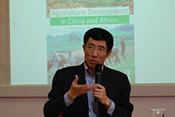
Professor Li Xiaoyun and Professor Qi Gubo of the Chinese Agricultural University in Beijing offered their perspectives based on the findings of their recently-published book, Agricultural Development in China: A Comparative Analysis
Focusing on China's experience of supporting agricultural development in Africa, they argued that China has made massive strides in achieving food security and poverty reduction, feeding 20 per cent of the world's population with only 8 per cent of the world's arable land. Lessons from this experience are potentially important for Africa, they said. China has experience of labour intensive agriculture supported by locally developed appropriate technologies. China's 'green revolution', they pointed out, was home-grown and based on long-term public investment in research, agricultural education and infrastructure, and was not reliant on market led development.
Panel 1: Brazilian cooperation for development: new paradigm for agricultural development in Africa? 

Setting Brazilian agricultural development cooperation in its geopolitical and policy context – what are the attributes of the Brazilian model and what challenges is it facing? Reflecting on lessons from different agricultural development models in Brazil and their implications for cooperation with Africa – how to get the blend right?

Panel 2: Agriculture, climate change and a green economy in Africa: what role for South-South?

Focusing on the opportunities and challenges for African agriculture [in the context of the Rio+20 and post-Durban agendas on sustainability], inclusive green growth and climate change mitigation – climate smart agriculture and the socioenvironmental lesson-learning process from Brazilian agricultural development. What lessons exist from including rural women for example? How can we do better rather than simply produce more?

Panel 3: Brazil and China in Africa: similarities and differences in South-South exchange 

Identifying contrasts and commonalities in Brazilian and Chinese approaches for agricultural development cooperation with Africa, and potential for future exchange – what might Brazil and China do together?

Related
guardian.co.uk, 10 May 2012. Chinese food security may be motivating investments in Africa Future need to import more food a possible influence in China's engagement with African agriculture, claims study.

Selasa, 27 Desember 2011

China's food security challenge: what role for Africa?

Africa will in the next decade increasingly play an important role in China’s long-term food security agenda as demand for food in the world’s most populous nation threatens to outstrip its supply, according to Standard Bank research analysts Simon Freemantle and Jeremy Stevens.

In their latest paper “China’s Food security challenge: What role for Africa?” published in November 2011 (13 pages), Mr Freemantle and Mr Stevens write that China is facing serious strains on both the demand and supply side of its agricultural sector and will in the next few years have to look externally to supplement its sources of food supply.

  • Who will feed China? Malthusian concerns around the world’s ability to provide sustenance for a rising population have often, as now, centered on China. With unrivalled agricultural potential, Africa too has been thrust to centre stage. Emotionally-fuelled estimations of China’s agricultural ambitions in Africa too often miss the mark. This paper assesses where (if at all) Africa fits into Beijing’s long-term food security agenda.
  • Food demand is rising rapidly in China. Rising incomes and urbanisation are leading to dramatic increases in food consumption in China. China now consumes the second most food in the world, behind the United States. It is expected that, by 2015, China’s total food expenditure will double to over USD1 trillion (tr).
  • Meanwhile, China is facing increasing strains on agricultural supply.  Urbanisation and industrialisation are swallowing up farmland, and diminishing water tables. Between 1996 and 2006, China lost 9 million (mn) hectares (ha) of farmland.
  • Boosting domestic sources of supply will be Beijing’s core response to these challenges. Agriculture’s broader role in maintaining social harmony in China is profound. Fortunately, China has the propensity and ability to boost domestic production. China is a net exporter of food and has enormous stockpiles of most soft commodities. Given pointed state support, China’s agricultural output is expected to swell by 26% to 2019. 
  • However, clear demand overhangs exist, meaning that China will have to seek external sources of nutrition. Two principle channels exist:
  • First, China will look to enhance trade ties with food exporting nations. Between 2001 and 2010 China’s imports of soybeans rose ten-fold, from USD2.8 billion (bn) to over USD25 bn, and rubber imports from USD2 bn to USD17 bn.
  • Africa is a bit player in China’s agricultural trade prospectus. 99% of China’s soybean imports come from the Americas, and three-quarters of rubber imports from the rest of Asia. In 2009, China-Africa agricultural trade was just USD4 bn, less than 4% of total trade. A disconnect exists between African agricultural export and Chinese agricultural import dynamics. That said, recent trade growth in certain commodities, such as cotton, has been impressive.
  • Second, China will align aid and outward investment in agriculture to access new opportunities. Here, Africa’s role is pronounced.  While cooperation remains developmental, signs of commercialism and strategic intent are clear. In general, state-owned farming groups carry out Beijing’s agricultural investments in Africa. As of 2009, China had carried out over 200 agricultural projects in Africa. Increasingly, these projects are run on a for-profit basis.
  • Estimations of Chinese “land grabs” in Africa are overstated. Gulf States, as well as private investors from throughout the developing and advanced world have led the thrust of recent land acquisitions in Africa. Beijing, alarmed by local sensitivities, has remained cautious.
  • Africa desperately requires capital and skills to elevate food security. Managed well, partnerships with China can be meaningful. However, domestic food security must be placed first. Then, and leveraging Chinese aid, crops suited for China’s demand dynamics can and should be emphasised. Increasingly, green technology will provide cogent opportunities.